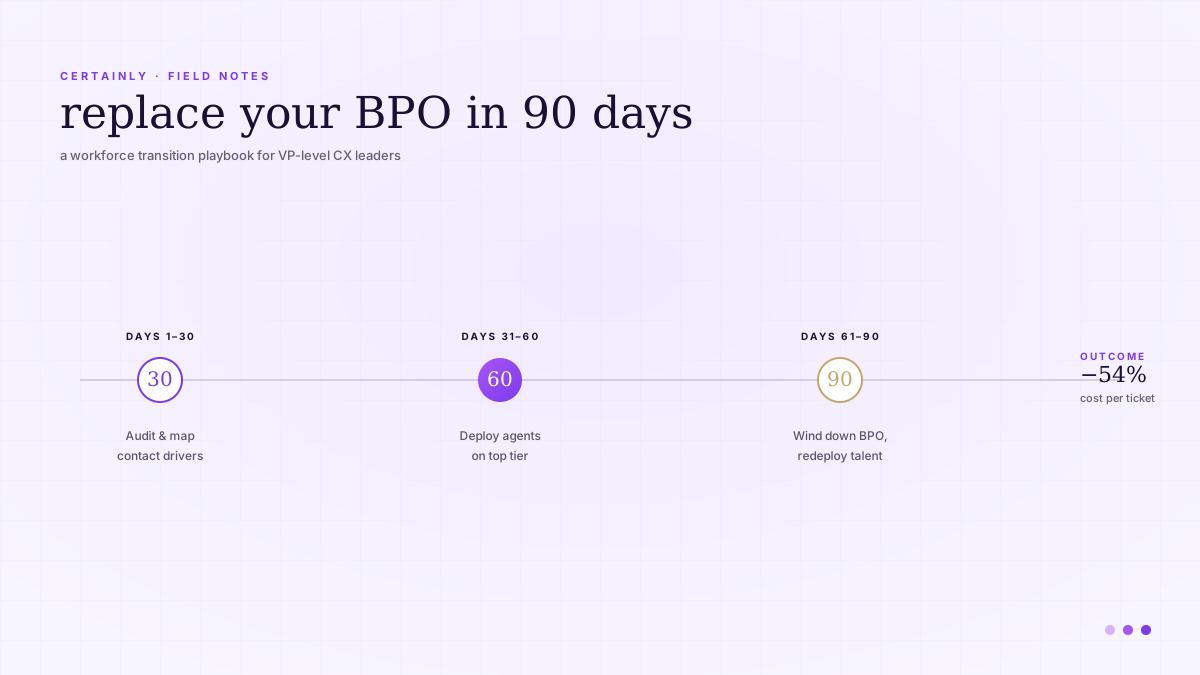
TL;DR
Most enterprise BPO contracts in CX cover the same five to seven contact drivers across two thirds of the volume. Those drivers are exactly the ones a well-built agentic AI deployment resolves in week three. The 90-day playbook is sequenced around contract terms, not technology readiness. Map the volume in days 1 to 30, deploy on the top tier in days 31 to 60, wind down the BPO commitment and redeploy internal talent in days 61 to 90. Done correctly, cost per ticket falls 40 to 55 percent and headcount stays whole.
Outsourced customer service made sense in a world where labor arbitrage was the only available scaling lever. AI changes the math. The leaders moving fastest are not the ones replacing BPOs with cheaper BPOs. They are the ones reclaiming the work, automating the predictable share, and redeploying their internal teams to the conversations that drive retention and revenue.
Why BPO Is Suddenly Vulnerable
Three changes in the last 18 months have made the BPO model structurally fragile.
Cost arbitrage has compressed. Wage inflation in traditional offshoring hubs has narrowed the gap between in-house and outsourced agents to under 30 percent in many regions, and the gap is shrinking each year.
Quality is harder to enforce remotely. Distributed BPO teams handling complex agentic workflows produce more variance than a single in-house team supported by AI. The variance shows up in CSAT, in compliance audits, and in escalation rates.
The AI floor is rising. Agentic AI now resolves cases that would have required a tier-two human three years ago. The cases that justified outsourcing in the first place are increasingly the cases the AI handles best.
Together, those three shifts mean a five-year BPO contract signed in 2023 is almost certainly mispriced today, and the renewal in 2027 will be mispriced by a wider margin.
Days 1 to 30: Audit and Map
The first month is reconnaissance. Pull twelve months of contact data from every channel and rank by volume, average handle time, and cost per contact. Most operations find that 60 to 75 percent of total volume falls into seven to ten case types.
Within those top types, separate the work into three buckets.
Resolvable. Cases that follow a deterministic policy and have a verifiable outcome. Order tracking, return initiation, password reset, account update, basic billing. These are AI work.
Augmentable. Cases that need human judgment but follow a structured path. Refund disputes, complex troubleshooting, retention saves. AI assists, human decides.
Reserved. Cases where human is the only correct answer. Bereavement, regulated complaints, executive escalations. Untouched by automation, supported by better tooling.
By the end of day 30, the deliverable is a one-page map of every case type and its bucket, with the current cost per case and the projected automated cost per case.
Days 31 to 60: Deploy and Verify
Month two is execution on the top three resolvable case types only. Resist the temptation to launch broad. Depth on a small number of journeys produces both better customer outcomes and a cleaner readout for the executive team that has to approve the BPO change.
The deployment pattern that works is the same in every operation we have seen.
Single-channel pilot. Pick the highest-volume channel and stand the agent up there first. Web chat is usually the fastest, WhatsApp second.
Connect the verifying systems. Order management, payment, identity, knowledge base. Without them, the agent is a chatbot and will produce containment without resolution.
Run in shadow mode for two weeks. The agent drafts a response, a human checks it, both responses are logged. The shadow period is where the policy and tone are calibrated.
Switch to live, with full handoff. Once shadow accuracy clears the quality gate, the agent goes live with a one-click human escalation path. The handoff path is what gives operations and the customer the safety to trust the system.
By day 60, the top three case types are largely automated, and the operational data exists to model the BPO contract change.
AI Readiness Score
How ready is your team for AI?
6 quick questions. Get a personalised score and action plan.
Try the AI Readiness Score1000+ agents deployed worldwide · 4.8 on G2
Days 61 to 90: Wind Down and Redeploy
Month three is the contractual and human work. The audit from month one and the data from month two go to procurement and the BPO partner.
Most master service agreements include a volume-flex clause that allows a renegotiation when sustained volume falls below a threshold. Even contracts without one are usually open to renegotiation when the alternative is a customer using the change-of-scope clause.
Internally, the redeployment is the difference between a successful programme and a politically toxic one. The agents whose case types have been automated are the people who understand those journeys best. They become the calibration layer for the AI, the quality reviewers, the escalation specialists, and the policy authors. None of those roles existed in the old operation, and all of them are higher value than the work they replace.
Done well, headcount on the internal side stays flat or grows, the BPO contract reduces by 40 to 60 percent, and the cases handled by humans are the ones that drive retention and brand.
What Goes Wrong
Three failure modes account for nearly every botched BPO transition.
Speed over depth. Teams launch six case types in month two, miss policy edge cases in three of them, and the executive sponsor loses confidence before the cost data lands.
Tooling without governance. The AI is deployed without permission scoping or audit, security flags it, and the programme stalls in legal review for the rest of the year.
Treating the BPO as the enemy. The smart partners are willing to renegotiate. The hostile ones write the breach notice. Approach the conversation as a contract restructuring, not a cancellation, and the path is shorter.
What This Looks Like 12 Months In
An operation that runs the 90-day playbook properly and continues iterating for the rest of the year tends to land in the same place: BPO spend down 50 to 65 percent, autonomy rate around 55 percent, internal headcount stable or up by ten percent in higher-value roles, and CSAT one to three points higher than the old operation produced.
That is the case for moving now rather than waiting for the next contract renewal. Every quarter spent operating on the old model is a quarter of paying offshore wages for work the AI is already cheaper, faster, and more consistent at delivering.