TL;DR
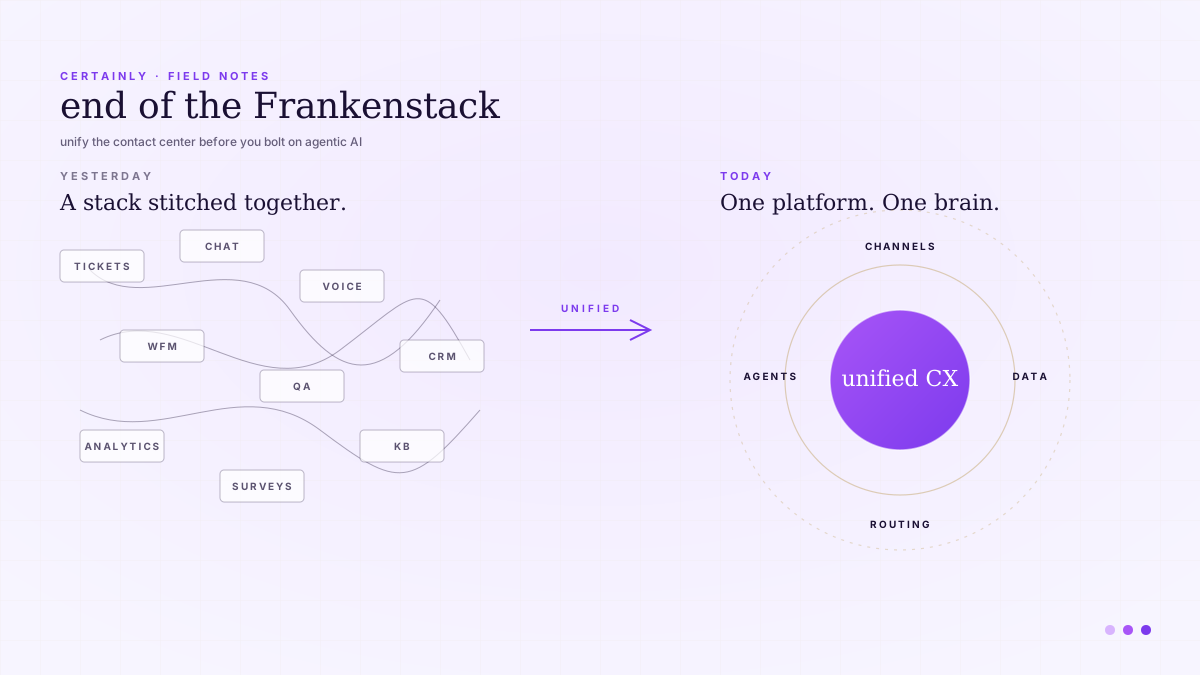
Most CX architectures today are a Frankenstack: best-of-breed tools wired together by custom APIs and goodwill. It worked when the work was siloed. It collapses the moment you try to deploy agentic AI on top, because the agents inherit every seam, every duplicate record, and every broken handoff. The teams pulling ahead in 2026 are doing the unglamorous work first: consolidating onto a unified platform with three clean layers (experience, intelligence, systems of record), then putting agents on top. The result is 41% more resolutions per agent and a system the security team will actually approve.
There is a quiet pattern in every CX project that fails to scale. Someone, years ago, picked a best-of-breed ticketing tool. A different team picked a best-of-breed WFM tool. Marketing picked a chat widget. The voice platform predates everyone. By the time agentic AI arrives, the architecture diagram looks less like a system and more like a family tree drawn by a true crime podcaster.
What a Frankenstack Actually Costs You
Every seam in your stack is a place where data leaks, latency builds, and accountability disappears. The cost rarely shows up on a single line item. It shows up everywhere at once.
Conversations restart at every channel switch because no system owns the customer record end to end. Reporting takes three teams and a spreadsheet because no platform agrees on what counts as a resolution. AI pilots stall because the model needs context that lives in seven systems, six of which require a different access ticket.
What was once "best-of-breed" now reads as "best-of-decade-old". Modern unified platforms have closed the capability gap on most categories that used to require a specialist tool, and the integration tax of staying fragmented now exceeds the differentiation benefit of any single component.
The Three Layers of a Unified CX Platform
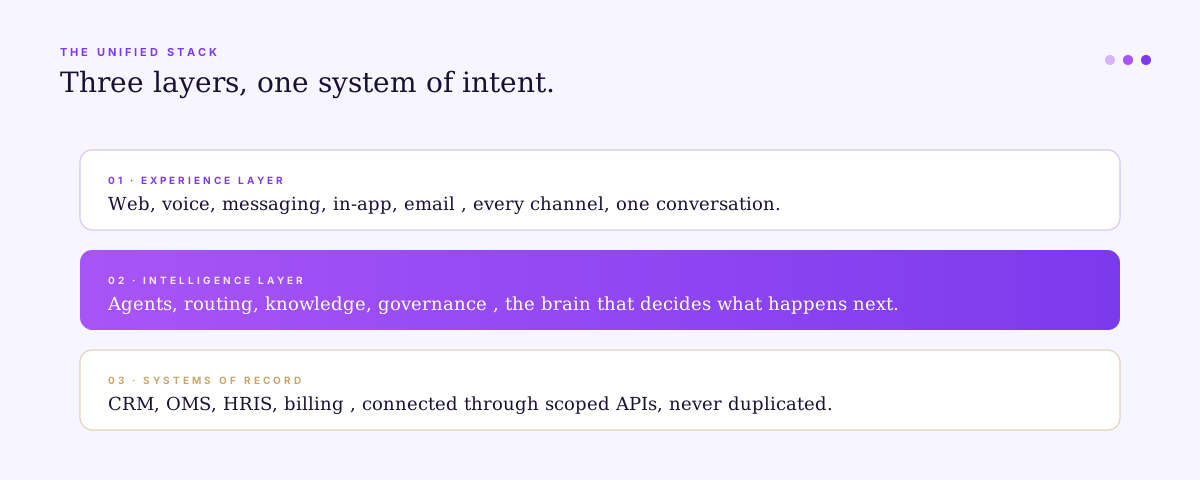
A platform worth consolidating onto has three clean layers, each with a single job. Mix them and you rebuild the Frankenstack one year later.
Experience layer. Web, voice, messaging, in-app, email. Every channel terminates in the same conversation object. The customer should never have to repeat their order number because they switched from chat to phone.
Intelligence layer. Agents, routing, knowledge retrieval, governance. This is the brain. It decides what happens next, which specialist to call, when to escalate, and what to log. Most legacy stacks do not have this layer at all. They have rules engines pretending to be one.
Systems of record. CRM, OMS, HRIS, billing, inventory. These do not move into the platform. They stay where they are, and the intelligence layer reads them through scoped APIs. Duplicating data into a CX tool is how you end up with three versions of the truth and a compliance officer with a headache.
Why Agentic AI Forces the Decision
A single AI agent can paper over a fragmented backend for a while. A multi-agent system cannot. The moment you have specialists, connectors, orchestrators, and governance agents trying to coordinate, every loose wire in your architecture becomes a production incident.
This is the part most vendors will not tell you: the value of agentic AI is bottlenecked by the cleanliness of the platform underneath it. You can buy the smartest agents on the market and still get mediocre results if they are reading from inconsistent records and writing into systems they do not have proper credentials for.
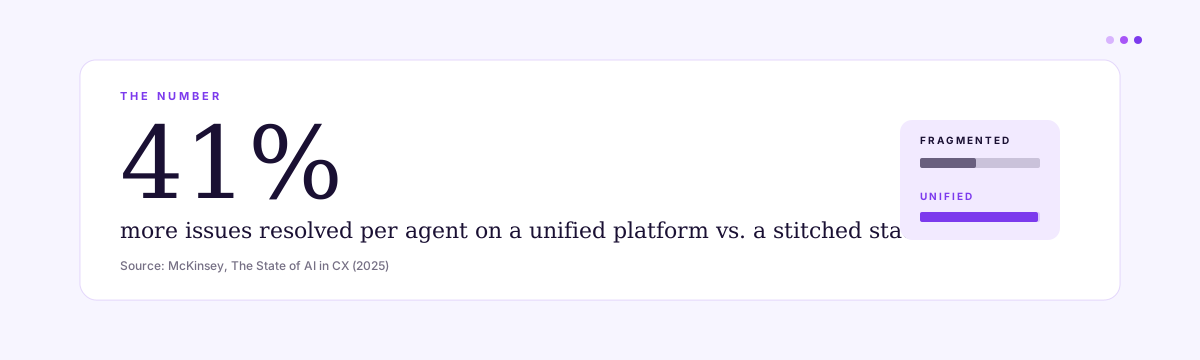
The data backs it. Recent McKinsey analysis found enterprises operating on a unified CX platform resolve 41% more issues per agent than those stitching together best-of-breed tools, even when the underlying AI capabilities are equivalent. Same models. Same prompts. Different floor under them.
AI Readiness Score
How ready is your team for AI?
6 quick questions. Get a personalised score and action plan.
Try the AI Readiness Score1000+ agents deployed worldwide · 4.8 on G2
What CX Leaders Should Do Now
Consolidation is not a six-month project. It is a sequence of decisions that compound. Three to start with.
Audit the seams, not the tools. Map every place a customer record, ticket, or conversation crosses a system boundary. Each crossing is a tax. Most teams find five to nine they did not know existed.
Pick a platform you can trust to own the intelligence layer. This is the layer that will compound in value. The systems of record can be swapped over time. The brain cannot.
Retire one component per quarter. Do not try to rip and replace. Identify the highest-tax seam, consolidate it onto the platform, prove the result, then move to the next. This is how the teams pulling ahead are doing it without a 24-month transformation freeze.
Patching legacy stacks with custom APIs was a 2018 strategy. In 2026, the unglamorous work of unifying first is the prerequisite for everything good that comes next.