# The mandate won't move them. The work will.
Every few months a new memo lands. "We're an AI-first business now." A tool gets switched on, a deadline gets set, and leadership waits for the productivity graph to bend upwards.
It rarely does. Not because the technology is weak, but because a mandate tells people what to use without ever showing them why it helps them. A decree changes the org chart. It doesn't change the Monday morning.
Conversational AI is where this gap shows up most clearly, and where it costs the most to get wrong.
Two ways to roll out the same tool
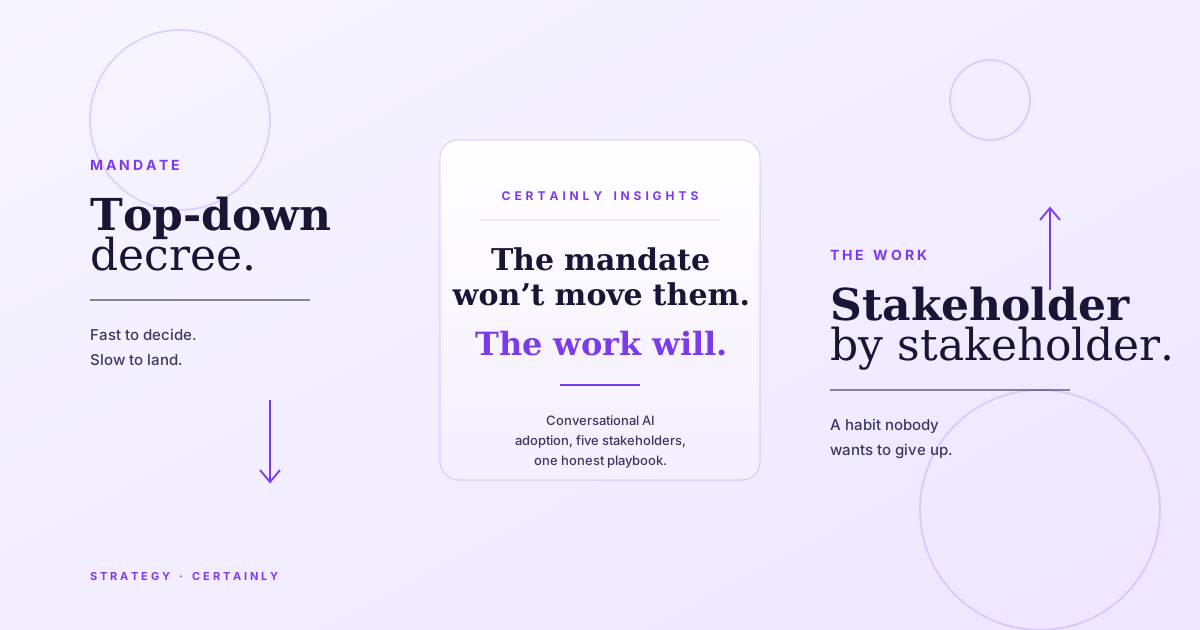
A mandate is top-down. Buy the platform, announce the policy, expect adoption. It's fast to decide and slow to land.
AI adoption change management is the opposite. It's the human work of preparing people, earning trust, and fitting the tool to how they already work, so the technology becomes a normal, useful part of the day rather than another login to resent.
Same software. Completely different outcome. One produces a tool nobody opens. The other produces a habit nobody wants to give up.
More than a chatbot on your storefront
It's easy to file conversational AI under "customer service" and move on. That's the conventional case, and it's a strong one: deflecting repetitive tickets, recommending products, lifting average order value.
But conversations are data, and data travels across the whole business. The real opportunity isn't a smarter widget on your website. It's a layer that helps finance, procurement, operations and the board each get something they actually need.
Certainly is a conversational AI platform, not a single-purpose CX or ecommerce tool. Below is what that means for the people who have to back it, buy it, use it, and answer for it.
For the C-suite: a strategy, not a slogan
Leadership doesn't need another tool. It needs outcomes that hold up over time.
Conversational AI gives the board a consistent brand voice at scale, a growing asset in first-party conversational data, and a way to grow service capacity without growing headcount at the same rate. The strategic win is optionality: the same platform supports new markets, new channels and new use cases without a new project each time.
The catch worth naming in the room: none of this lands by decree. The C-suite's real job is to fund the adoption work, not just sign the purchase order.
For finance: cost-to-serve you can actually see
Finance lives with the questions a mandate ignores. What does this cost per resolution? Where's the revenue leaking? Will this scale predictably?
Conversational AI gives finance a clearer line of sight. Cost to serve becomes measurable rather than assumed. Patterns in returns, cart abandonment and repeat questions point to where money is leaking before it shows up in the quarter. And because automated conversations don't scale linearly with headcount, growth stops meaning "hire more people to answer the same questions".
The honest framing for finance: judge it on cost per outcome and revenue retained, not on licences bought.
AI Readiness Score
How ready is your team for AI?
6 quick questions. Get a personalised score and action plan.
Try the AI Readiness Score1000+ agents deployed worldwide · 4.8 on G2
For procurement: fewer tools, clearer risk
Procurement's nightmare is shelfware: a platform bought in a hurry, half-integrated, and quietly abandoned.
A conversational AI platform earns its place by replacing point solutions rather than adding to them, fitting the existing stack instead of forcing a rebuild, and standing up to proper scrutiny on security, reliability and total cost of ownership. The right questions are the ordinary ones: does it integrate, who owns the data, what happens at renewal, and is anyone actually using it ninety days in.
Procurement's leverage here is real. Buy for adoption, not just price, and write the success measures into the decision.
For on-the-ground operatives: a tool, not a threat
This is where mandates fail hardest. Hand a frontline team a tool that makes their day harder, or seems to be there to replace them, and they'll quietly route around it.
Done well, conversational AI does the opposite. It clears the repetitive, low-value queries so people spend their time on the work that needs a human. It hands agents and operatives the right answer fast, instead of an interruption to a colleague. It removes the boring part of the job, not the job.
Trust is everything with this group. Involve them early, let them shape it, and they become the strongest case for adoption you have.
For IT and operations: it has to fit
Behind every smooth rollout is a team making sure the tool connects to what's already there.
Operations and IT want integration over islands, control over guardrails and tone, and reporting that turns conversations into something the rest of the business can act on. Get this layer right and every other stakeholder's win becomes possible. Get it wrong and the best strategy on the slide goes nowhere.
Adoption is a multi-stakeholder problem
A mandate treats the business as one audience. It isn't. Each of these people judges the same tool by a different yardstick:
- C-suite wants sustainable growth and a defensible data asset. Read the 90-second CEO brief →
- Finance wants a lower cost per outcome and predictable scaling. Read the 90-second CFO brief →
- Procurement wants fewer tools, real integration and managed risk. Read the 90-second Procurement brief →
- Operatives want the boring work gone, not their roles. Read the 90-second CX Operations brief →
- IT and operations want something that fits the stack and stays in control. Read the 90-second CIO brief →
Hand them all the same memo and most will quietly opt out. Show each of them their own win and you don't need a memo at all.
Case Studies
See how teams deploy 1000+ agents worldwide
Real results from Feastables, Fintiba, Quad Lock, and more.
Try the Case Studies1000+ agents deployed worldwide · 4.8 on G2
The point
You can't decree trust. You can only build it, one stakeholder and one genuinely useful case at a time.
Conversational AI rewards the businesses that do the human work first: name the real use cases, match them to the people who'll benefit, and let value, not policy, drive adoption.
That's the difference between a tool you've installed and a tool your teams would fight to keep. If you want to map the adoption work to your own stakeholders, speak to the Certainly team for advice.