TL;DR
AI multilingual support is decisively cheaper than native-speaker hiring in most major Latin-script markets, particularly when conversation volume per language sits below the threshold that justifies a dedicated team. It is competitive but not yet dominant in markets where cultural nuance and politeness conventions carry contractual weight, such as Japan, Korea, and parts of the Gulf. The right framework is per-market, not global. CX leaders should classify each target market on two axes , volume and nuance load , and assign AI, hybrid, or human accordingly.
Cross-border expansion has always been a headcount problem disguised as a translation problem. You could not enter a market without hiring native speakers, and you could not justify hiring native speakers without enough volume to keep them busy. The result was a ratchet that locked most companies into three or four languages.
AI multilingual support breaks the ratchet. The question is no longer whether to operate in 20 languages. It is which of those 20 languages need humans behind the AI, and where the AI alone is the better answer.
What Has Actually Changed
Three capabilities have matured at once and produced the inflection.
Translation quality has converged with native fluency in most major languages. For the top 25 languages by digital commerce volume, the gap between a well-prompted modern model and a competent human native speaker is now smaller than the gap between two human native speakers from different regions of the same language.
Tone and register transfer correctly. Earlier translation systems flattened politeness markers. Modern systems preserve them, including in languages with formal honorific systems such as Korean and Japanese, when the prompt is written for it.
Round-trip latency is below the perception threshold. A customer messaging in Polish gets a Polish reply, generated and delivered in under two seconds. The conversation feels native because the latency is.
Together those three changes mean the AI is no longer a translation layer over an English process. It is a multilingual agent operating in the customer's language end to end.
A Two-Axis Framework
Not every market behaves the same way under AI. The decision framework that holds up across our deployments is built on two axes.
Volume per language. How many conversations per month does the market generate? Below 200 conversations, AI is almost always the right answer because no human team can be staffed economically. Above 5,000, the question becomes whether a small human team adds enough value to justify itself.
Nuance load. How sensitive is the market to cultural register, politeness convention, and idiomatic precision? German, French, Spanish, Dutch, and English variants carry low to moderate nuance load for transactional support. Japanese, Korean, Arabic, and many Southeast Asian languages carry high nuance load, particularly in regulated or relationship-driven sectors.
Cross those two axes and three deployment patterns emerge.
Pure AI. Low to moderate nuance load, any volume below the staffing threshold. Most European markets in transactional commerce, most Latin American markets, most Anglophone tertiary markets.
Hybrid. Moderate to high nuance load, moderate to high volume. AI handles the conversation, a small native-speaking quality team reviews a sample and handles escalations. Most major Asian markets, regulated European markets, premium retail and finance.
Human-led with AI assist. High nuance load, high volume, high stakes. Japan in financial services, Korea in luxury retail, Gulf markets in private banking. AI suggests and translates, humans always send.
The mistake is to apply one global policy. The cost differential between the three patterns is large enough that getting the assignment right at the per-market level is the difference between an expansion that funds itself and one that does not.
The Cost Curve
The cost numbers in our deployments cluster in a predictable way.
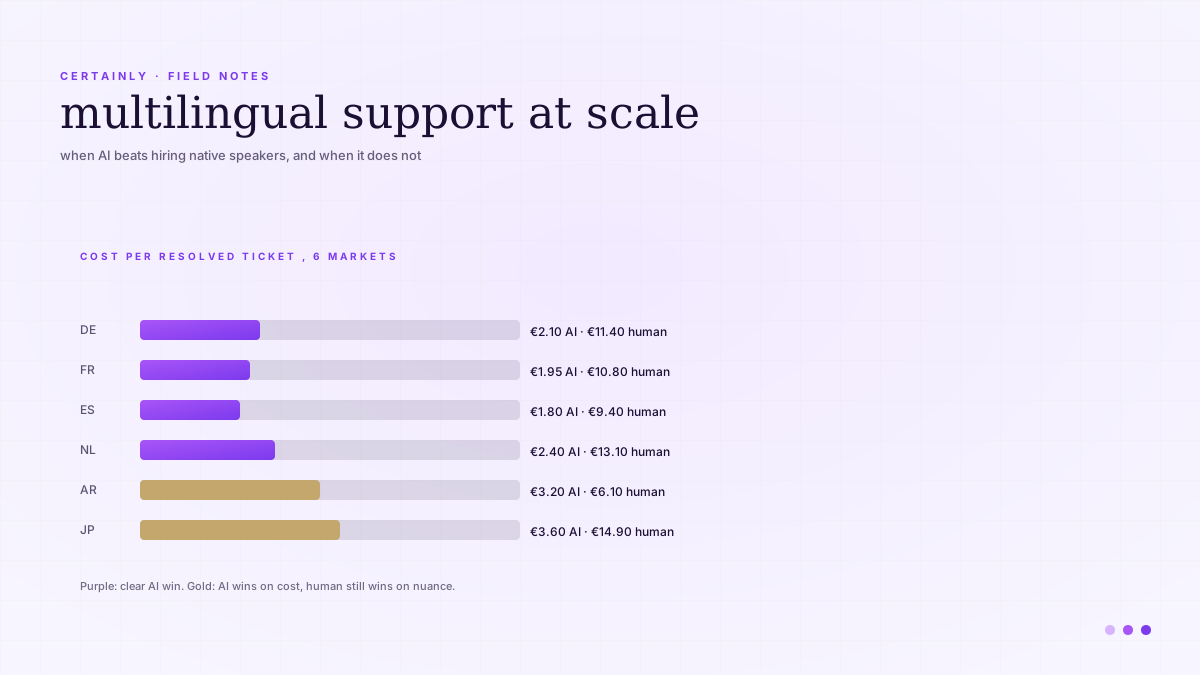
Pure AI markets sit at €1.50 to €2.50 per resolved ticket, including model and platform cost. The same ticket resolved by a native-speaking human in those markets sits at €9 to €13.
Hybrid markets sit at €2.50 to €4.00 per resolved ticket once the quality team is included. The full-human equivalent sits at €11 to €16.
Human-led markets sit at €8 to €14 per ticket, but with AI assist that lifts agent throughput by 30 to 45 percent, the effective cost falls to €6 to €10. Pure AI in those markets ranges from €3 to €4 per ticket but produces measurably worse outcomes that show up in CSAT and in retention.
Across a typical multi-market portfolio, blended cost per resolved ticket falls 55 to 70 percent against an all-human baseline, and CSAT remains flat or improves by one to three points.
AI Readiness Score
How ready is your team for AI?
6 quick questions. Get a personalised score and action plan.
Try the AI Readiness Score1000+ agents deployed worldwide · 4.8 on G2
What Goes Wrong
Three patterns account for nearly every multilingual AI deployment that underperforms.
Single global prompt. The same system prompt is used across all languages, so register and tone do not transfer. Politeness markers are missing in Japanese, formality is wrong in German, idiom is too literal in Spanish. The fix is per-language prompt tuning, not better translation.
No native review on day one. Even pure-AI markets benefit from two or three weeks of native-speaker review during launch to catch register and culture issues the model handles fluently in some contexts and badly in others.
Treating long-tail languages as zero-cost. Adding a 28th language because the marginal cost is near zero is correct. Failing to govern that language with the same evals discipline as the top three is not. The long tail is where reputational risk hides.
The Practical Move
For a CX leader running a multi-market operation today, three steps make the framework operational.
Classify every market on the two axes. Volume and nuance load. The output is a one-page matrix that tells you which pattern each market belongs to. That single document will make the next budget cycle considerably easier.
Stand up pure AI in the long tail first. The markets you currently support badly because no human team makes economic sense are exactly the ones where AI produces the largest visible improvement.
Restructure, do not expand, the human teams in the high-nuance markets. The native speakers who used to handle every ticket become quality reviewers, escalation specialists, and cultural calibration leads. Their per-ticket touch goes down. Their per-customer impact goes up.
Multilingual support used to be an expansion bottleneck. In 2026 it is, for most companies, an opportunity to support more markets at lower cost without sacrificing the customer experience that the human teams used to be the only way to deliver.