TL;DR
If you need an AI customer service agent live for the 2026 UK holiday peak, your decision window closes in mid-September. The platforms that genuinely ship inside six weeks at mid-market scale are Certainly, Ada and Zendesk AI. Five features actually matter under peak load; everything else is sales theatre.
The Real UK E-Commerce Peak Calendar
Black Friday week 2026 (27 November), Cyber Monday (30 November), December gift-buying surge, the Boxing Day sales spike, the January returns wave. The combined window from mid-November to mid-January typically delivers 35–45% of annual support volume into a four-month period (IMRG, 2024–25). The teams that handle it cleanly look superhuman. The teams that do not lose CSAT, repeat business and stock that is in returns purgatory instead of back on the shelf.
What 'Quick Deployment' Actually Means
Six weeks from kickoff to live for a scoped, single-language UK e-commerce deployment is a realistic floor. Two weeks is a fantasy unless you are deploying a static FAQ widget that will collapse the moment a customer asks about an order. The vendors who claim 'minutes to live' are usually deploying minutes to a public webpage; the integration, training and pilot work still takes six weeks and someone has to do it.
A Six-Week UK E-Commerce Deployment Plan
Week 1: Scope freeze and knowledge ingest. Top 10 ticket types selected by volume × handle time. Knowledge base cleaned and ingested. Success metrics agreed (containment, CSAT, cost per contact).
Weeks 2–3: Integrations. Live connection to your e-commerce platform (Shopify, BigCommerce, Magento), your helpdesk (Zendesk, Gorgias, Freshdesk), and your shipping/tracking provider. This is where most projects slip; insist on click-through connectors over bespoke API work where possible.
Week 4: Agent training and transcript replay. Replay last year's peak transcripts through the agent. Hand-correct edge cases. Tune escalation thresholds.
Week 5: 10% pilot. Live traffic on 10% of conversations. Daily review with the vendor. Hard go/no-go on containment and CSAT.
Week 6: Full rollout with on-call. 100% traffic, vendor on call for the first 14 days, war-room channel between your team and theirs.
AI Readiness Score
How ready is your team for AI?
6 quick questions. Get a personalised score and action plan.
Try the AI Readiness Score1000+ agents deployed worldwide · 4.8 on G2
Five Features That Matter Under Peak Load
- 1.Order-status integration that calls your e-commerce platform live. Stale data is worse than no data when a customer is asking where their Christmas present is.
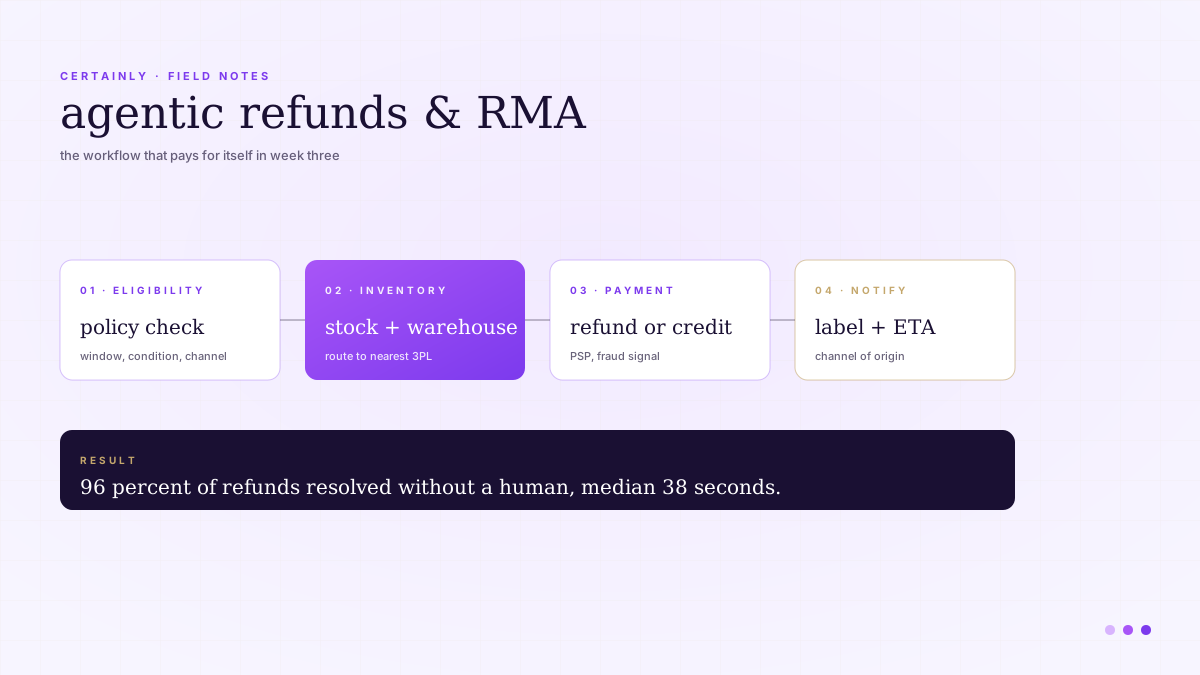
- 1.RMA and refund workflows the agent can execute end-to-end. A bot that creates a ticket for a human to process is not deflection, it is deferral.
- 1.Multilingual coverage if you ship beyond the UK. Cross-border failure rates spike at peak.
- 1.Clean human handoff at the frustration moment. Sentiment-triggered escalation, full context to the human, no repeat-yourself loop.
- 1.Per-conversation pricing that does not collapse under spike volume. Vendors charging per resolution can become unpredictable when peak traffic balloons; vendors charging per agent seat make AI a punishment for success.
Platforms That Realistically Ship in Six Weeks
Certainly ships routinely inside six weeks on Shopify, Salesforce and Zendesk-connected stacks, with UK e-commerce reference customers.
Ada typically six to eight weeks, depending on integration depth.
Zendesk AI four to six weeks if you are already on Zendesk.
Salesforce / Fin usually 10–14 weeks; possible to compress with a dedicated SI but rarely worth the risk for a holiday deadline.
The fuller honest comparison is in our 2026 buyer's comparison of AI chatbots and the Shopify-specific deep dive in the complete guide to deploying an AI agent on Shopify.
Common Holiday Deployment Mistakes
Starting procurement in October. Scoping every ticket type instead of the top ten. Skipping the 10% pilot to save a week. Choosing a per-resolution price without modelling spike behaviour. Believing the vendor demo without running last year's transcripts through it.
Next Step
If you want to be live by mid-November with a UK-anchored deployment plan, book a working session and we will scope a realistic six-week plan against your actual stack and ticket mix. The earlier in summer we start, the calmer your December looks.