TL;DR
Refund and RMA is the case type with the worst ratio of strategic value to operational cost in most e-commerce CX operations. It is also the case type where agentic AI produces the cleanest, fastest, most defensible business case. A four-stage agentic workflow , eligibility, inventory, payment, notification , resolves 90 to 96 percent of refund and RMA conversations without a human, in a median time under 45 seconds, and pays back its deployment cost inside three weeks at any meaningful volume.
Returns are where the e-commerce P&L goes to die. The cost of accepting them is high, the cost of denying them wrong is higher, and the customer is rarely happy regardless of the answer. Outsourcing the work compounds the cost without improving the outcome. Templating the responses produces precisely the cold experience that drives the next return.
Agentic AI is the structural fix.
Why Refunds Are the Perfect First Workflow
Three properties make refund and RMA an unusually good candidate for agentic AI, which is why it is almost always the case type we recommend automating first.
The policy is deterministic. Window, condition, channel of purchase, payment method. Every branch has a defined answer. The AI is not making judgment calls, it is executing a policy that already exists in writing.
The verifying systems are well-defined. Order management for purchase data, warehouse for stock and routing, payment service provider for the refund, notifications for the customer. Four well-known integrations, all of which have stable APIs.
The customer signal is immediate. Within minutes of resolution the customer knows whether the answer was right. The feedback loop is short enough to tune the system quickly.
Compared with troubleshooting, retention, or sales-adjacent conversations, refund and RMA is the closest thing to a closed-form problem in a customer-facing context.
The Four-Stage Workflow
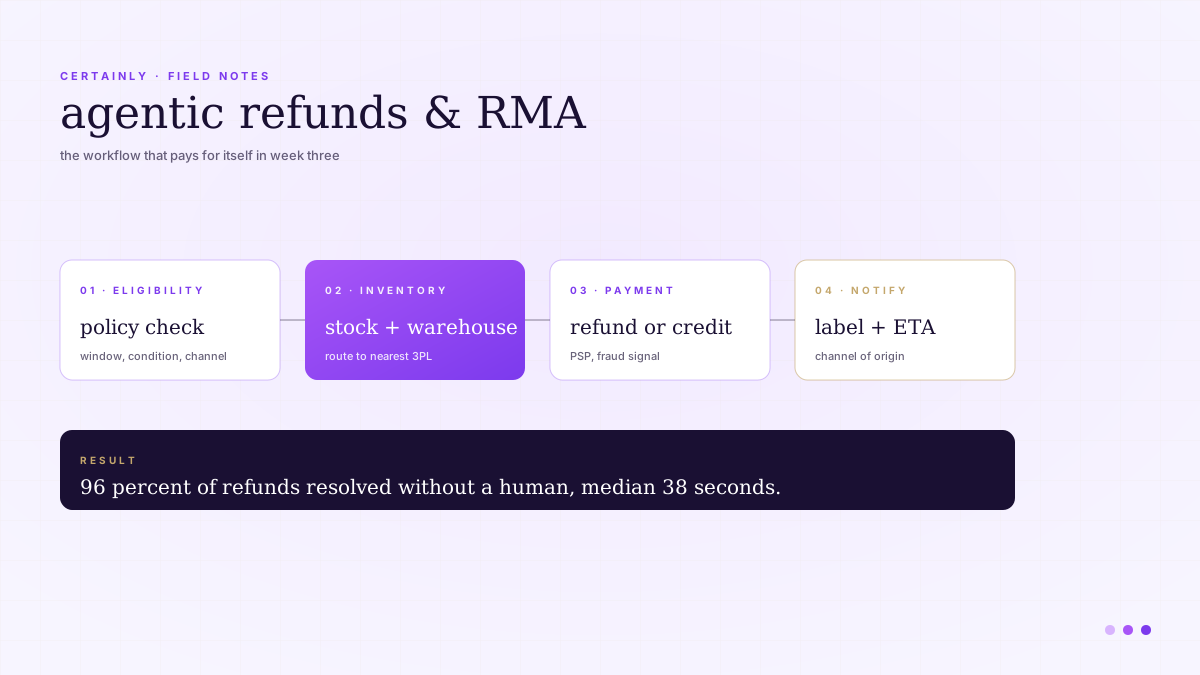
Every working agentic refund and RMA implementation follows the same four-stage structure. The stages are sequential, with each one gated on the success of the previous.
Stage one: eligibility. The agent identifies the customer, retrieves the order, and runs it against the published refund policy. Window of purchase, item condition declared by the customer, channel of original purchase, exclusions for sale or final-sale items, and any geography-specific consumer law that overrides the default policy.
Stage two: inventory and routing. If the case is a return, the agent checks current stock and warehouse capacity, then routes the return label to the closest fulfilment node. For digital goods or refund-only cases, this stage is skipped.
Stage three: payment. The agent issues the refund through the payment service provider used at purchase, or offers store credit if the policy or customer preference dictates. A fraud signal check runs in parallel and pauses the refund if anything anomalous appears.
Stage four: notification. The agent sends confirmation through the channel the conversation originated on, with the refund amount, the expected timing, the return label if applicable, and a verifiable reference number. The customer experience ends in the channel where it began.
Done correctly, the four stages take a median of 38 seconds end to end. The variation is mostly in stage two, where warehouse routing introduces real-world latency.
What the Numbers Look Like in Production
Across deployments we have run, the steady-state numbers cluster tightly.
Containment rate sits between 92 and 96 percent on refund and RMA specifically, which is materially higher than the same operation's overall containment because the case type is so well-defined.
Median time to resolution is 35 to 45 seconds, against 12 to 22 minutes on the same case type when handled by a human, which includes the human's time to retrieve the order, validate eligibility, process the refund, and send the notification.
Cost per resolved case falls from €4 to €8 (human) to €0.15 to €0.40 (AI), a reduction of roughly 95 percent.
CSAT on automated refund cases tends to run two to four points above human-handled cases, because the speed of resolution outweighs the loss of human contact for a transaction that customers want done quickly.
AI Readiness Score
How ready is your team for AI?
6 quick questions. Get a personalised score and action plan.
Try the AI Readiness Score1000+ agents deployed worldwide · 4.8 on G2
Where It Goes Wrong
Three failure modes account for almost every refund and RMA agent that underperforms.
Policy divergence. The agent is built against a written policy that does not match what humans have actually been doing. The first 100 cases produce a flood of escalations because customers were used to a more generous interpretation. The fix is to audit the human-handled cases first and codify the actual operating policy, not the published one, before deployment.
Inventory race conditions. The agent issues a return label for an item the warehouse cannot accept because stock or capacity has shifted in the seconds between checks. The fix is a hold-and-confirm pattern in stage two, with the warehouse acknowledging capacity before the label is generated.
Payment-side failures handled badly. The PSP rejects the refund for a reason the agent cannot interpret, and the customer is left in limbo. The fix is a single, well-defined fallback to a human escalation queue with full context, never a generic 'we will get back to you' message.
The 14-Day Rollout
A focused refund and RMA deployment fits a two-week timeline.
Days 1 to 4: audit human-handled cases, codify the actual operating policy, define the four-stage workflow, agree the human escalation criteria.
Days 5 to 8: integrate order management, warehouse, payment, and notification systems. Build the eligibility logic against the codified policy. Stand the agent up in shadow mode.
Days 9 to 12: shadow mode, with humans reviewing every agent response and scoring it. Calibrate policy edges, tone, and escalation handoff.
Days 13 to 14: switch to live on a single channel, with monitoring on every stage transition. Open the second channel once the first is stable.
From day 15 onward, the agent is in production, the cost line moves, and the human team is freed for the cases that genuinely need their judgment.
What This Means for the Operation
Refund and RMA is the wedge case. The numbers are clean enough to convince a sceptical CFO inside a month, the workflow is contained enough to deploy without a long change-management programme, and the customer experience improves rather than degrades.
Once it is live, the same four-stage pattern generalises to subscription cancellations, address changes, order modifications, and warranty claims. The team that builds the refund agent first has the operational template for the next five workflows already in hand.