TL;DR
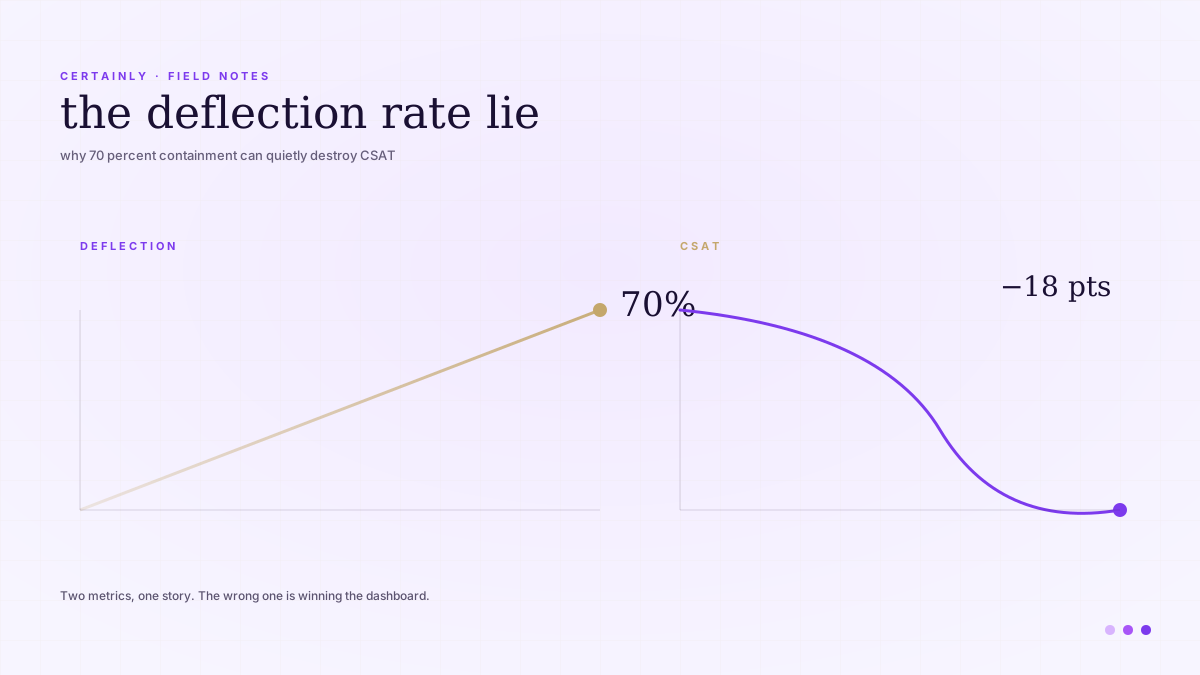
Deflection rate measures how often a human is avoided. It does not measure whether the customer was helped. Many CX organisations are quietly trading 18 to 25 CSAT points for a containment number that looks great in a board pack. The fix is not to abandon containment, it is to demote it. The metric set that should run a 2026 CX function is autonomy rate, first contact resolution, post-resolution CSAT, and effort score, with deflection sitting underneath them as a diagnostic, not a goal.
Containment has become the vanity metric of customer service. It is easy to measure, easy to celebrate, and easy to game. The problem is that it tells you almost nothing about the experience the customer had on the way to that contained conversation.
A bot that closes a chat window because the customer gave up is contained. A bot that loops a frustrated user through three reformulations of the same answer is contained. A bot that quietly tells someone their order cannot be refunded, when in fact it can, is contained. None of those are wins.
Where the Deflection Number Comes From
Most deflection rates are calculated as a single ratio: conversations that did not reach a human, divided by total conversations. The denominator hides the failure modes.
Three patterns drive inflated deflection numbers in nearly every operation we have looked at.
Abandonment masquerading as resolution. A customer asks a question, gets a generic response, and closes the window. The system records no human handoff and counts the conversation as contained. CSAT for that customer was never measured because they never came back to take the survey.
Forced self-service loops. The agent cannot solve the problem, but the path to a human is hidden three menus deep. Customers either give up or escalate through a different channel. The original channel logs a clean containment, the support inbox catches the same issue under a different ticket ID.
Policy-shaped lying. The most damaging pattern. The agent gives an answer that is technically inside policy but materially wrong for the situation. The customer accepts it because they do not know better. Two weeks later they are a churn statistic.
All three of those count as wins on the dashboard. None of them are wins for the business.
What the CSAT Curve Actually Shows
When you graph deflection rate against post-resolution CSAT across a typical scaling deployment, the relationship is not linear. It is shaped like a hockey stick.
Up to roughly the 55 to 60 percent containment range, CSAT and deflection move together. The bot is taking the genuinely simple cases off the human queue, agents have more time per ticket, and the customer is happier in both channels.
Past 60 percent, the two metrics decouple. Past 70 percent, they invert. The bot is now intercepting cases it should not be handling, and the customers it is intercepting are the ones with the highest expectation of resolution. CSAT in that segment falls 15 to 20 points within a quarter, and the loss does not show up in the contained channel because those customers stop responding to surveys.
A Better Metric Set
The fix is not to throw containment out. It is to put it underneath the metrics that actually describe the customer outcome.
Autonomy rate. The percentage of conversations that the AI fully resolved end to end, verified by a downstream signal. The signal can be a refund completed, an order updated, a password successfully changed, a follow-up survey returned. Autonomy rate is what containment was always supposed to measure.
First contact resolution, channel-agnostic. Whether the issue was solved in one round of contact, regardless of which channel or whether the human or the AI did it. Multi-channel resolution counts as a failure here, even if each channel logged a clean containment.
Post-resolution CSAT, segmented by channel and by autonomy. Survey customers after the issue is verifiably closed, not after the conversation ends. Segment by who resolved it. If AI-resolved CSAT is more than five points below human-resolved CSAT for the same case type, the AI is the wrong tool for that case type.
Customer effort score. The single best predictor of churn in service-driven businesses. CES rises sharply when a customer is bounced between channels, even if every individual channel reports it contained the contact.
AI Readiness Score
How ready is your team for AI?
6 quick questions. Get a personalised score and action plan.
Try the AI Readiness Score1000+ agents deployed worldwide · 4.8 on G2
Reading the Diagnostic, Not the Trophy
Once those four metrics sit at the top of the dashboard, deflection becomes useful again. It tells you where the AI is intercepting cases. CSAT and effort tell you whether it should have. The intersection of the two is where the real operational decisions live.
If deflection is high and autonomy is low, the AI is closing cases without resolving them. That is the deflection lie in numbers.
If deflection is high, autonomy is high, but CSAT is dropping in a specific case category, the AI is solving the wrong way. Tone, transparency, or escalation policy needs work.
If deflection is moderate, autonomy is high, and CSAT is rising in both channels, the deployment is working. That is the curve every CX leader should be aiming for, and it usually peaks somewhere between 55 and 65 percent containment, not 80.
What to Do This Quarter
Three moves will move the conversation in any organisation that is currently optimising on deflection alone.
Stop reporting deflection at the executive level. Move it down into the operations dashboard. Replace it at board level with autonomy rate and segmented CSAT. The change in conversation is immediate.
Survey the contained tail. Take a sample of conversations the AI marked as resolved without escalation, and survey those customers a week later. The delta between operational CSAT and that delayed-survey CSAT is the size of the deflection lie in your operation.
Set autonomy targets, not deflection targets. Aim for 50 to 55 percent autonomy in year one of a serious agentic deployment, with CSAT held flat or rising. That is a number worth celebrating, and one that will not collapse the moment a competitor measures honestly.
Containment was the right metric for the IVR era. It is the wrong one for the agentic era. The leaders who get this right in 2026 will look like they are growing slower in containment numbers and faster in everything that pays the bills.