TL;DR
A single AI agent, no matter how capable, can only resolve about 20% of what a service team does on a given day. The remaining 80% spans messy data, multiple systems, and decisions that cross team boundaries. Solving it requires a multi-agent architecture: domain specialists, system connectors, orchestration agents, and governance agents working as a coordinated ecosystem. The unlock is not raw intelligence. It is structure, scope, and governance.
Most AI agents in production today are doing the easy work. They answer a question, fill a form, or pull a record. Useful, but a fraction of what a real service team handles every hour.
The hard part is everything else. Replacing an employee laptop is not one task. It is eligibility against a return policy, an inventory check, a warranty validation, a procurement coordination, and updates across two or three systems of record before anyone tells the employee what happens next. A single agent cannot reach across all of that without losing the plot, and it should not try.
The Single-Agent Ceiling
Most current AI in customer service is workflow automation in a new wrapper. It executes predefined steps and follows scripts, and it breaks the moment reality stops matching the template.
Even a well-designed single agent reasoning inside a confined context only solves for a narrow set of variables. It can parse intent, identify the right policy, and respond in clear language. What it cannot do is hold the whole enterprise in its head. Each downstream system has its own data model, its own access controls, and its own failure modes. One agent attempting to be the generalist for all of them becomes a liability the moment it touches anything sensitive.
This is the ceiling. And it is structural, not a model problem.
What a Multi-Agent Ecosystem Actually Looks Like
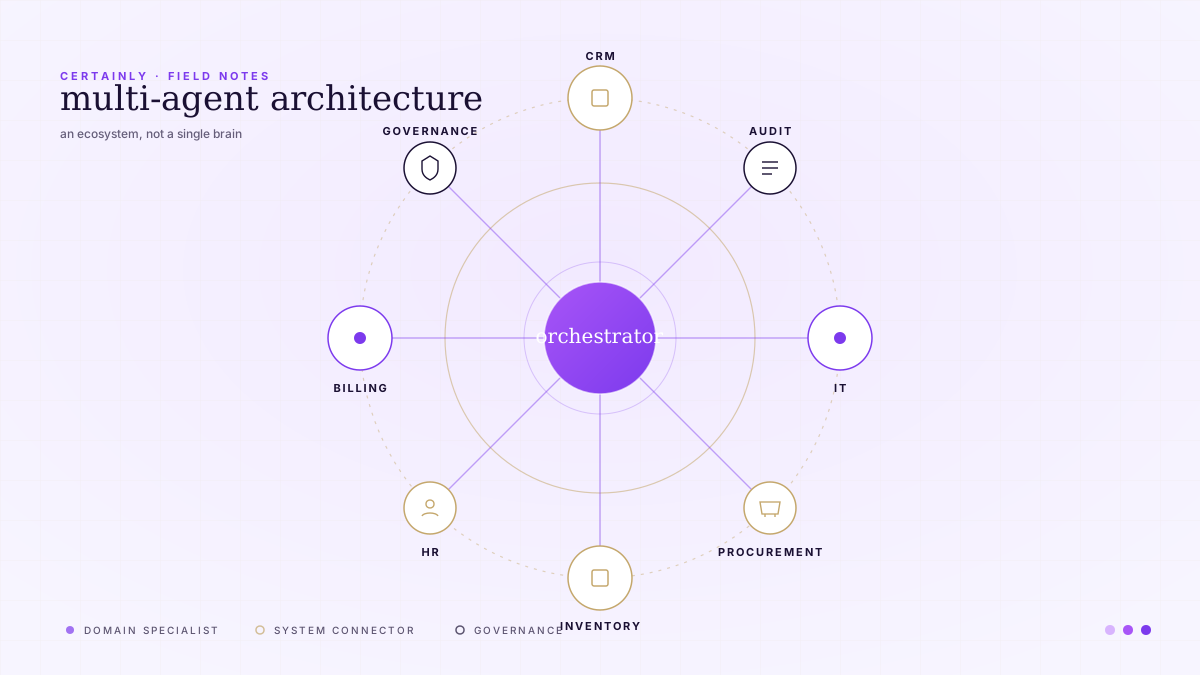
The way human service organisations work is the right mental model. No single person resolves a complex case end to end. Specialists own their domain, connectors interface with specific systems, coordinators route work, and a layer of governance keeps everyone inside policy.
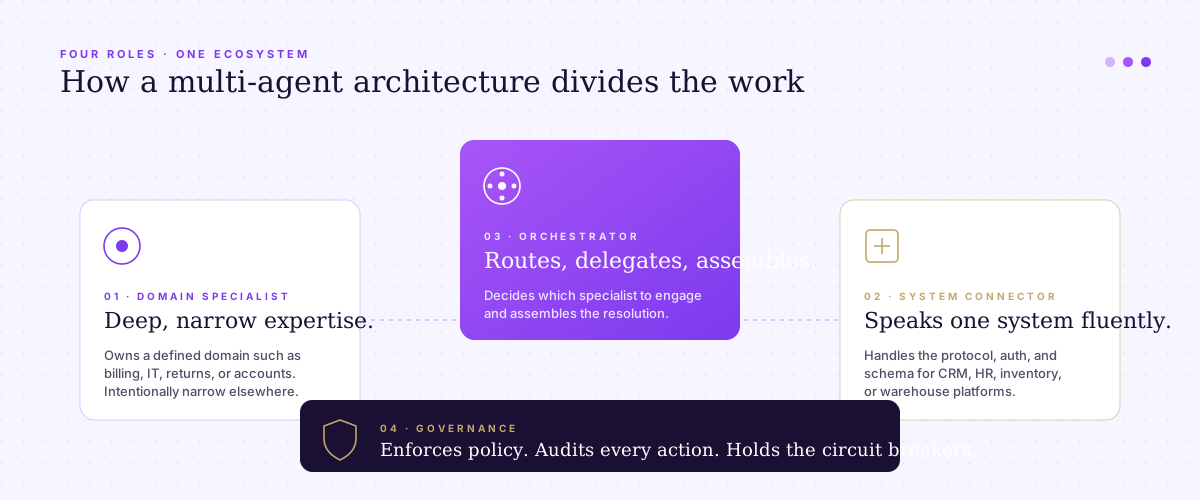
A mature multi-agent architecture mirrors this with four roles.
Domain specialists. Focused expertise in a defined area such as IT support, billing, account management, or returns. They are deep where they need to be, and intentionally narrow elsewhere.
System connectors. Agents whose job is to talk to a single platform: the HR system, the inventory database, the CRM, the warehouse management tool. They handle the protocol, the auth, and the schema so the specialists do not have to.
Orchestration agents. The coordinators. They route work, decide which specialist to engage, manage handoffs, and assemble the final resolution from the pieces.
Governance agents. The policy layer. They enforce access rules, audit actions, manage escalations, and intervene when something is about to step outside agreed boundaries.
This is not theoretical. It is how enterprises that are scaling agentic AI past pilots are organising the work today.
Why Governance Is the Real Adoption Question
Multi-agent systems unlock the 80% of service work that single agents cannot reach. They also create new risk surfaces. More agents means more credentials, more data movement, more decisions executed without a human in the loop. Without a governed framework, that is exactly the kind of system enterprise security teams will refuse to deploy at scale.
Four controls separate experimental multi-agent setups from ones that can run a real business.
Permission-aware data access. Agents read data through scoped APIs. They do not copy it into new systems where it can drift out of governance.
Credential delegation. Each agent operates with the minimum permissions needed for the task at hand, time-limited and tied to a specific job.
Execution transparency. Every agent action is logged, auditable, and traceable to the business policy that authorised it.
Circuit breakers. Automatic guardrails that halt runaway processes before a small failure becomes a systemic one.
Without these, multi-agent ecosystems remain a slide. With them, they become production infrastructure.
AI Readiness Score
How ready is your team for AI?
6 quick questions. Get a personalised score and action plan.
Try the AI Readiness Score1000+ agents deployed worldwide · 4.8 on G2
Architecture That Reflects Real Service
Most current agent benchmarks assume clean data and well-scoped problems. Real service is the opposite. Data is partial, systems fail, and a single inquiry routinely spans multiple teams.
A multi-agent architecture worth deploying is one designed for that messiness from the start. It distributes authority, expects adaptation, and lets the system improve with experience while staying inside the guardrails the business has set.
This is the difference between a demo that handles the predictable 20% and an architecture that earns the right to touch the other 80%.
What CX Leaders Should Do Now
The shift from single agents to multi-agent systems is the next real inflection point in customer service automation. The leaders who get there first will resolve more, escalate less, and operate with a level of consistency their competitors cannot match without rebuilding from the ground up.
Three practical moves to start with.
Map the 80%. Take your top contact drivers and mark which ones cross more than one system or team. Those are the cases a single agent will never resolve well, and the ones a multi-agent architecture is designed for.
Define the four roles. Even on a small initial deployment, separate domain logic, system access, orchestration, and governance. Collapsing them into one agent is the fastest way to reach the ceiling described above.
Lead with governance. Decide your access, audit, and circuit-breaker rules before you deploy the first agent, not after. Retrofitting governance onto a live multi-agent system is expensive and slow.
Single agents got the industry to the door. Multi-agent architecture is what walks through it.