TL;DR
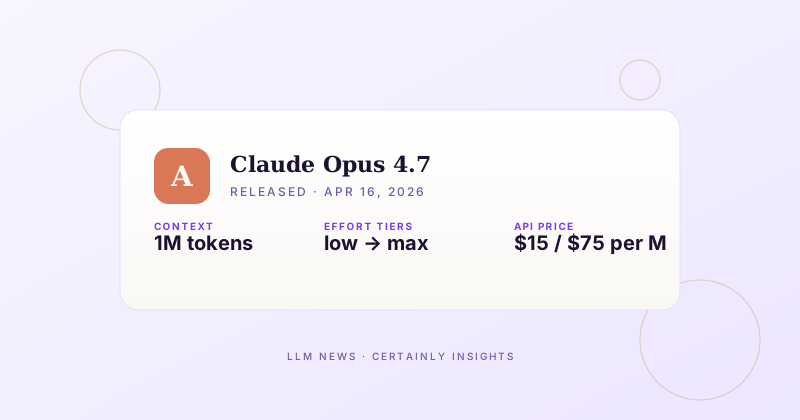
Anthropic released Claude Opus 4.7 on April 16, 2026 as the new flagship in the Opus line. Headline changes: a 1M token context window now generally available on the premium tier, a new xhigh effort level slotted between high and max, materially better coding and agentic benchmarks, and sharper vision. API pricing stays at the Opus tier (around $15 per million input tokens and $75 per million output tokens, with prompt caching and batch discounts). Available today on claude.ai, the Anthropic API, Amazon Bedrock, Google Cloud Vertex AI, and Microsoft Foundry.
For CX leaders, the practical question is not whether Opus 4.7 is impressive. It is whether it earns its price tag inside a production support stack where 80 percent of traffic should never touch a frontier model in the first place.
What Actually Shipped
Anthropic positions Opus 4.7 as a hybrid reasoning model focused on agentic coding, complex multi-step work, and high-resolution vision. Three changes matter operationally.
1M token context, generally available. The 1M window first appeared in beta on Opus 4.6 in February. With 4.7 it is a stable, supported feature on the premium tier. That is enough to drop an entire knowledge base, ticket history, and policy document into a single prompt without retrieval gymnastics.
New xhigh effort tier. Opus 4.7 adds a fifth reasoning depth between high and max. The intent is finer cost and latency control: you get most of the reasoning quality of max without paying its full latency tax. For CX, this is the tier that maps cleanly to escalated tickets and complex commerce flows.
Sharper agentic coding and vision. Independent reviewers report a roughly 13 percent jump in coding benchmark scores over Opus 4.6, with vision capability more than tripling on standard suites. Agentic tasks (multi-tool, long horizon) are where the gap is widest.
Pricing in Plain Numbers
The Opus tier remains expensive on a per-token basis. Public API pricing sits at roughly $15 per million input tokens and $75 per million output tokens, with prompt caching reads at a fraction of that and batch processing offering further discounts. Claude.ai subscriptions (Pro, Max, Team, Enterprise) bundle Opus 4.7 access with weekly usage limits, which Anthropic reset on launch day.
Compared to lighter models in the Claude family or to Gemini 2.5 Flash and GPT-5 Mini, Opus 4.7 is 10 to 30 times the cost per token. That is the right ratio for the work it is meant to do, and the wrong ratio for the bulk of customer service traffic.
Industry Reception
Coverage in the first 24 hours converges on three points.
Coding is the headline. 9to5Mac, Caylent, and PrimeAIcenter all lead with the software engineering improvements. The framing is that Anthropic is not pushing the frontier tier down market this cycle, it is making the premium tier more useful for long-horizon agent work.
Migration is mostly painless. Caylent and others note that the API surface is unchanged. Teams already on Opus 4.6 can swap the model ID (claude-opus-4-7) and ship. The deeper migration question is around the new xhigh tier and how to map it into existing routing logic.
The 1M context changes architecture. Multiple reviewers point out that with a stable 1M window, retrieval-augmented patterns become optional for a class of workloads that previously required them. That has cost implications in both directions.
AI Readiness Score
How ready is your team for AI?
6 quick questions. Get a personalised score and action plan.
Try the AI Readiness Score1000+ agents deployed worldwide · 4.8 on G2
What This Means for CX Teams
Opus 4.7 is not a drop-in replacement for the model handling your tier-1 contact volume. It is a strong upgrade for the 5 to 15 percent of conversations where reasoning quality, long context, or multi-tool agentic behaviour determines the outcome.
Use it for escalations and complex tickets. A B2B support ticket that needs to read three months of conversation history, two contracts, and a product changelog before answering is exactly the workload Opus 4.7 was built for. Route those there.
Use it for the supervisor layer in a multi-agent setup. If you run an orchestrator that decides which sub-agent or tool to invoke, Opus 4.7 is a credible choice for that supervisor. The cost per decision is high, but the cost of a wrong routing decision is higher.
Use it for long-horizon commerce and refunds. Agentic refund and RMA flows that touch order systems, inventory, and policy at the same time benefit from the new xhigh tier. Expect cleaner tool selection and fewer mid-flow stalls.
Do not use it for greeting messages, FAQ lookups, or password resets. The unit economics will collapse. Keep those on smaller, faster models.
How to Wire It In Without Burning Budget
The architecture that makes Opus 4.7 pay for itself is the same multi-model pattern Certainly customers already run for GPT-5 and Gemini 2.5 Pro: a routing layer that picks the cheapest model capable of resolving the contact at the required quality bar.
A reasonable starting policy looks like this. Light intent classification and templated answers stay on a flash-class model. Anything with a tool call, a memory lookup, or an escalation flag goes to a mid-tier reasoning model. Anything that hits a complexity threshold (long history, multiple tools, ambiguous policy) routes to Opus 4.7 at high or xhigh effort.
Run that policy for two weeks, then look at three numbers: per-resolution cost, autonomy rate (verified end-to-end resolution), and post-resolution CSAT for the Opus-handled segment. If autonomy and CSAT are both materially above the mid-tier model on the same case mix, the price premium is paying for itself. If they are not, the routing rules are wrong, not the model.
The Honest Caveats
Opus 4.7 is two months old as of writing. A few things to watch.
Latency at xhigh and max effort is real. For synchronous chat, plan for streamed responses and visible thinking states or the perceived experience suffers regardless of answer quality.
Weekly limits on the consumer plans (Pro, Max) reset on launch but are tighter than many teams expected. For production workloads, the API or the Team and Enterprise plans on claude.ai are the right path.
The 1M context is technically stable, but cost scales linearly with input tokens. A 900K-token prompt at Opus rates is not a small line item. Prompt caching helps materially when the bulk of the context is reused across turns.
What to Do This Week
Three concrete moves for a CX leader who wants to evaluate Opus 4.7 without reorganising the stack.
Route 5 percent of escalated traffic to Opus 4.7 at high effort. Keep everything else on whatever you are running today. Measure autonomy, CSAT, and cost per resolution against the control group for two weeks.
Pick one long-context use case and prototype it. Refund flows, B2B account questions, or anything that currently requires a human to read history are good candidates. Use the 1M window to skip retrieval and see if the answer quality is materially better.
Decide your supervisor model. If you run a multi-agent setup, run a head-to-head between Opus 4.7 and your current supervisor on the same 100 cases. The model that picks the right sub-agent more often wins, even if the per-call cost is higher.
Anthropic has shipped a strong model. The discipline that makes it valuable in a CX operation is the same as it has always been: route the work to the cheapest model that can do it well, and pay the premium tier only when the case actually needs it.
Try it directly at claude.ai or via the Anthropic API. To see how Certainly routes contacts across Opus, GPT, and Gemini in production, book a demo.