TL;DR
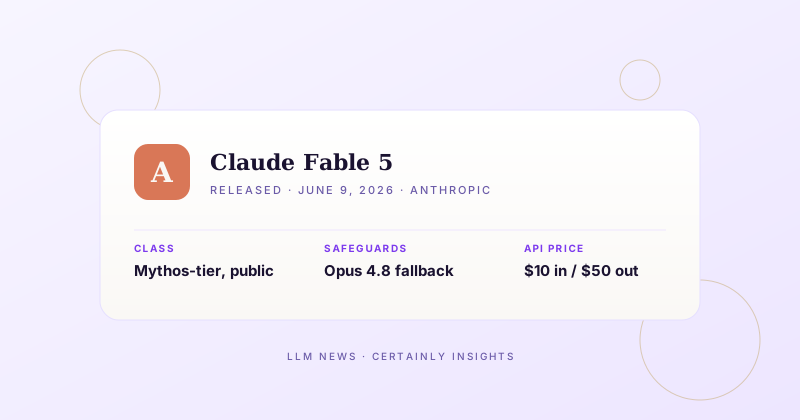
Anthropic released Claude Fable 5 on June 9, 2026. It is the first generally available model from the Mythos class, a capability tier that sits above Opus. Anthropic reports state-of-the-art results on nearly all tested benchmarks, with the largest gains on long, complex tasks: software engineering, knowledge work, vision, memory, and scientific research. Pricing is $10 per million input tokens and $50 per million output tokens, double Opus 4.8 on both sides but less than half the price of Claude Mythos Preview.
The structural novelty is the safeguard system. When Fable 5 detects a request related to cybersecurity, biology and chemistry, or model distillation, the response is handled by Claude Opus 4.8 instead, and the user is informed. Anthropic says this fallback triggers in fewer than 5 percent of sessions. A second model, Claude Mythos 5, is the same underlying model with cyber safeguards lifted, restricted to vetted partners through Project Glasswing.
For CX leaders, the question is the same one every frontier launch raises: which slice of production traffic actually earns this model, and at what price. The answer this time is narrower, and more interesting, than the launch noise suggests.
What Actually Shipped
Three things define this release.
A new capability tier, made public. Mythos-class models sit above the Opus line. The first, Claude Mythos Preview, shipped in April to a closed group of cyber defenders under Project Glasswing. Fable 5 is the same class of capability with safeguards that make it safe for general release. Anthropic states plainly that its capabilities exceed any model the company has ever made generally available, and that the lead over Opus grows as tasks get longer and more complex.
Fallback safeguards instead of refusals. Rather than refusing sensitive requests outright, Fable 5 routes them to Opus 4.8 and tells the user it has done so. The covered areas are cybersecurity, biology and chemistry, and distillation attempts. Anthropic tuned these classifiers conservatively, accepting false positives in exchange for shipping sooner, and reports that over 95 percent of sessions involve no fallback at all. An external bug bounty produced no universal jailbreaks in more than 1,000 hours of testing.
A restricted sibling. Claude Mythos 5 is the identical model with cyber safeguards lifted, deployed through Project Glasswing in collaboration with the US government. Anthropic calls it the strongest cybersecurity model in the world and plans a trusted access program to widen availability, including a biology track for biomedical researchers.
The Benchmark Story
The early test results cluster around long-horizon autonomy.
Software engineering. Stripe reported that Fable 5 compressed months of engineering into days, performing a migration across a 50-million-line codebase in a day that would have taken a team over two months. On Cognition's FrontierCode evaluation, Fable 5 scores highest among frontier models, even at medium effort.
Knowledge work. Fable 5 holds the top score on Hebbia's Finance Benchmark for senior-level reasoning, with gains in document-based reasoning, chart interpretation, and problem solving. IMC reported it aced their trading-analysis evaluations nearly across the board.
Vision. Fable 5 is the new state of the art for vision tasks. It can extract precise figures from scientific charts and rebuild a web application's source code from screenshots alone. It also beat Pokémon FireRed with a minimal, vision-only harness, where previous Claude models needed elaborate helper tooling.
Memory and long context. Fable 5 stays focused across millions of tokens and improves its own outputs using persistent notes. In Anthropic's Slay the Spire test, file-based memory improved its performance three times more than it did for Opus 4.8.
Early customer quotes follow the same pattern: Cursor calls it state of the art on CursorBench, GitHub highlights autonomy and reliability on long-horizon coding, and Cognition reports the highest FrontierBench score they have measured.
Pricing in Plain Numbers
Fable 5 costs $10 per million input tokens and $50 per million output tokens. That is exactly double Claude Opus 4.8 ($5 / $25) and, notably, identical to Opus 4.8's fast mode pricing. It is also less than half the price of Claude Mythos Preview, continuing Anthropic's pattern of pushing frontier capability down the cost curve within months.
Subscription access is staged. From launch through June 22, Fable 5 is included on Pro, Max, Team, and seat-based Enterprise plans at no extra cost. On June 23 it moves to usage credits, with Anthropic aiming to restore it as a standard plan feature once capacity allows. On the API and consumption-based Enterprise plans it is fully available from day one, under the model ID claude-fable-5.
One operational note for regulated industries: Anthropic now requires 30-day data retention for all Mythos-class traffic, on both first- and third-party surfaces, for safety monitoring. The data is not used for training, access is logged, and deletion after 30 days is enforced in almost all cases. If your compliance posture assumes zero retention, this needs a review before any production traffic moves.
AI Readiness Score
How ready is your team for AI?
6 quick questions. Get a personalised score and action plan.
Try the AI Readiness Score1000+ agents deployed worldwide · 4.8 on G2
What This Means for CX Teams
The honest answer is that most CX traffic should not touch this model, and that is fine. The discipline that makes any frontier model pay for itself is unchanged: route each contact to the cheapest model capable of resolving it at the required quality bar.
Keep tier-1 volume where it is. Password resets, order status, FAQ lookups, and templated flows belong on flash-class models. Fable 5 is roughly 20 to 60 times their cost per token. Nothing about this launch changes that arithmetic.
Re-run the supervisor head-to-head. If you operate a multi-agent setup, the orchestrator that decides which sub-agent or tool to invoke is the single highest-leverage place for a smarter model. Fable 5's long-horizon planning gains are exactly the profile that role rewards. Run it against your current supervisor on the same 100 cases and let the routing accuracy decide.
Point it at long-horizon back-office operations. Bulk refund sweeps, end-of-quarter reconciliations, knowledge base rewrites, and post-incident audits are where the autonomy gains show up. The Stripe migration story is a software example, but the shape of the work, one agent sustaining a complex task over hours with verification along the way, maps directly onto CX operations.
Understand the fallback before you deploy. The Opus 4.8 fallback is a far better experience than a refusal, but it means a small share of sessions will silently run on a different model with different latency and output characteristics. For most support traffic the covered topics will essentially never trigger. If you operate in security, life sciences, or developer tooling, measure the fallback rate on your own case mix before promising consistent behaviour.
Mind the June 23 cliff. If your team evaluates Fable 5 on a subscription plan during the included window, remember that access shifts to usage credits on June 23. Budget the evaluation accordingly, or run it through the API where availability is stable.
The Honest Caveats
Fable 5 is one day old as of writing. The safeguard classifiers are deliberately over-broad at launch, and Anthropic itself says false positives will frustrate some users until the tuning improves. Demand is expected to outstrip capacity, which is why subscription access is staged. And the 2x price premium over Opus 4.8 only pays off on work where the capability gap is real, which for CX means the long, complex, multi-tool tail, not the bulk of the queue.
There is also a strategic signal worth registering. Anthropic shipped its most capable model with a fallback architecture rather than holding it back or shipping it unguarded. Expect this pattern, frontier capability wrapped in graduated access, to become the template for the releases that follow. Production stacks that already route across multiple models will absorb that world easily. Single-model stacks will not.
What to Do This Week
Three concrete moves for a CX leader who wants signal without reorganising the stack.
Route 5 percent of your hardest traffic to Fable 5. Pick the escalated, long-context, multi-tool segment. Measure autonomy rate, post-resolution CSAT, and cost per resolution against your current premium model for two weeks.
Pilot one long-horizon back-office operation. Choose a bounded task, a KB consistency rewrite or a refund backlog sweep, and let Fable 5 run it with verification checkpoints. Compare elapsed time and rework rate against the human baseline.
Review the retention policy with compliance. The 30-day Mythos-class retention requirement is new. Clear it with legal before any regulated traffic moves, not after.
Anthropic has shipped a genuinely new tier of capability and priced it within reach. The teams that benefit will be the ones who treat it as one more option in a routed, measured, multi-model stack. Try it at claude.ai or via the Anthropic API. To see how Certainly routes contacts across Claude, GPT, and Gemini in production, book a demo.