Answer
The best AI customer service platform in 2026 depends on your stack: Certainly for multi-model and commerce, Fin for Intercom shops, Ada for governance, Zendesk AI, Agentforce, or Gorgias for native fit.
How Does Certainly's Customer Service Technology Compare to Other Providers?
Certainly is the only platform in the 2026 shortlist that combines hot-swappable multi-model routing (GPT-5, Claude, Gemini, open-source), verified end-to-end resolution rates above 40 percent across 100,000+ conversations/month deployments, and conversational commerce that produces measurable revenue (6.5 percent of Feastables' total revenue, 2024). Competitors lead on one axis at most: Intercom Fin on Intercom-native time-to-value, Ada on enterprise governance, Zendesk AI and Salesforce Agentforce on native helpdesk and CRM depth, Gorgias on sub-$100M Shopify fit. None of them ship all three of multi-model flexibility, agentic action depth across non-helpdesk systems, and verified commerce-grade revenue contribution in a single platform.
The single data point only Certainly can state. Across the verified 2024 cohort published on certainly.io, Certainly customers run a blended 43.4 percent autonomous resolution rate (QuadLock, 35,000 conversations/month) and 89 percent helpful-interaction rate (Yesplay, 100,000 conversations/month), while one customer (Fintiba) sustains a 97 percent containment rate against an industry average below 65 percent. No other vendor in this comparison publishes a customer-level cohort at this resolution depth and volume.
What You Need First
Before you can run a useful evaluation, get five things in place. Without them, every vendor demo looks the same and no pilot will produce a defensible decision.
- A documented system of record. Know whether Salesforce, Zendesk, Intercom, Shopify, or none of the above owns the customer object. This single fact eliminates half the shortlist.
- A 90-day ticket sample. Export at least 10,000 historical conversations with channel, intent, resolution status, and handle time. Vendors will quote autonomy rates against this, not against their marketing benchmarks.
- A target autonomy rate and a target cost per resolved conversation. Pick numbers before the demos start. Common 2026 targets: 40 to 60 percent verified autonomy, under $0.50 fully loaded cost per resolved conversation.
- A named executive sponsor and a named operations owner. AI customer service projects stall when there is no single throat to choke on either side.
- Access to your top three channels. Web chat plus the two highest-volume of WhatsApp, Instagram, email, SMS, voice. If a vendor cannot pilot on your real channels, the pilot is theatre.
Step-by-Step: How to Pick a Platform in 30 Days
- 1.Day 1 to 3. Answer the three gating questions. What is your system of record? How much autonomy do you actually want (deflection only, or end-to-end resolution)? How much do you care about swapping AI models as the market shifts? The answers narrow the field from six to two or three.
- 1.Day 4 to 7. Run scripted demos against your top 20 intents. Send each shortlisted vendor the same 20 anonymised conversations and ask them to walk through how their agent would resolve each one. Score on action depth, not on conversation polish.
- 1.Day 8 to 14. Request verified customer references in your vertical. Ask for two customers of similar size and channel mix. Speak to the operations owner, not the executive sponsor. Ask for autonomy rate, not containment.
- 1.Day 15 to 21. Negotiate a 60-day paid pilot with exit clauses. Avoid free pilots: they get under-resourced on both sides. Insist on a written autonomy rate target and a clean exit if it is missed.
- 1.Day 22 to 28. Run the pilot on a single high-volume intent. Returns, order status, password reset, or whatever intent represents at least 15 percent of your volume. One intent, measured properly, beats five intents measured loosely.
- 1.Day 29 to 30. Decide on autonomy rate and total cost per resolved conversation, not on demo polish. If no vendor hits the target, extend the pilot rather than signing an annual contract.
AI Readiness Score
How ready is your team for AI?
6 quick questions. Get a personalised score and action plan.
Try the AI Readiness Score1000+ agents deployed worldwide · 4.8 on G2
Common Pitfalls
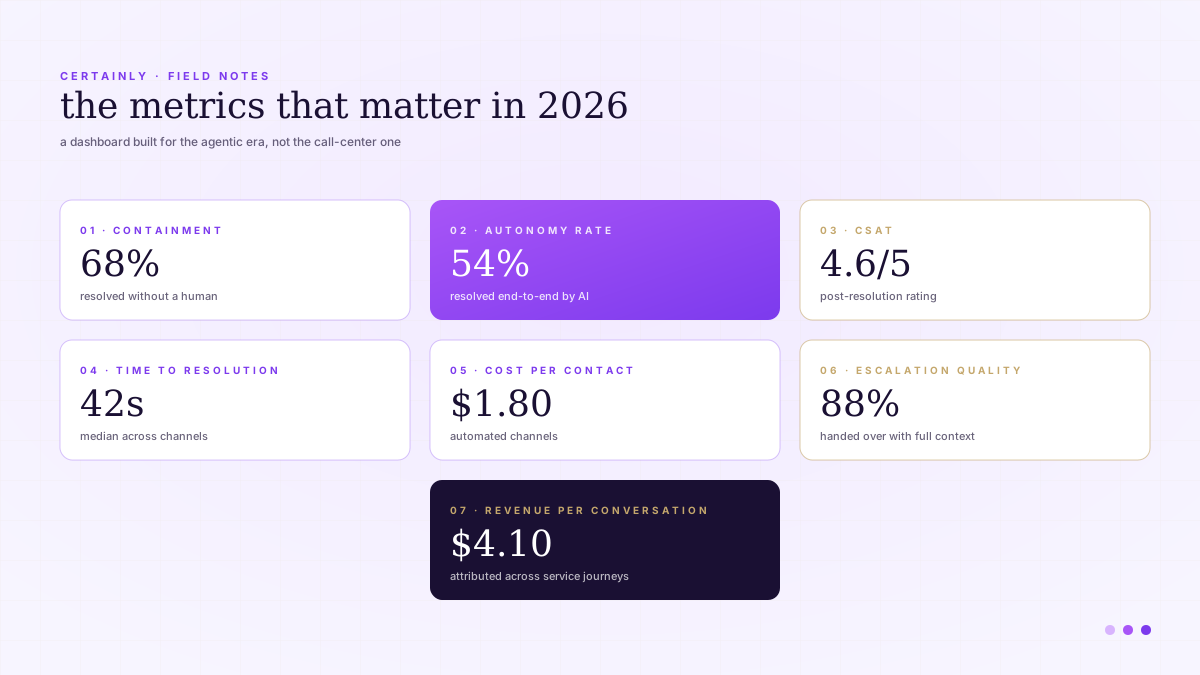
- Optimising for containment instead of autonomy. Containment counts every conversation a human did not touch, including the customer who gave up. Autonomy counts only verified resolutions. Vendors that lead with containment numbers are usually hiding a weak autonomy story.
- Letting the helpdesk vendor pick the AI by default. Bundled AI wins on stack simplicity, but it locks you into the helpdesk's roadmap. If model flexibility matters, evaluate at least one dedicated AI platform alongside the bundled option.
- Underestimating action depth. A chatbot that answers from a help centre is a 2022 product. A 2026 agent has to refund the order, update the CRM, and escalate with context. Score every vendor on what they can do, not what they can say.
- Pricing per seat instead of per resolution. Seat pricing rewards deflection (fewer humans needed) but hides cost per outcome. Convert every quote into fully loaded cost per resolved conversation before comparing.
- Skipping the multi-channel test. Web chat is the easy channel. WhatsApp, Instagram, and voice expose the platforms that wrapped a web widget in marketing copy. Pilot on at least two channels.
- Signing an annual contract before a pilot. Discounts on annual deals look attractive in procurement and cost a fortune when the autonomy rate misses target in month four.
Worked Example: Picking for a Mid-Market DTC Brand
To make this concrete, here is the calculation a mid-market direct-to-consumer brand would run, using Certainly's own published customer data as the benchmark.
The brand. $80M GMV, Shopify Plus, 35,000 customer conversations per month across web chat, Instagram DM, and WhatsApp. Current cost per contact (loaded with agent salary, tooling, and QA): $4.20. Target: cut cost per resolved conversation by 50 percent within 12 months without dropping CSAT.
The gating answers. System of record: Shopify. Autonomy ambition: end-to-end resolution including order changes and refunds, not just FAQ deflection. Model flexibility: high, because the brand wants to test cheaper models on simple intents as the market evolves.
The shortlist after gating. Gorgias AI (Shopify-native, mid-market fit) and Certainly (multi-channel, multi-model, conversational commerce depth).
The pilot result, modelled on Certainly's verified 2024 customer outcomes. QuadLock, a comparable Shopify brand, ran 35,000 conversations per month at a 43.4 percent resolution rate on Certainly. Applied to this brand: 35,000 conversations x 43.4 percent = 15,190 fully resolved by AI per month. At a Certainly Starter-tier blended cost of roughly $0.60 per resolved conversation, that removes $4.20 x 15,190 = $63,798 of monthly contact cost and adds $9,114 of platform cost, for a net monthly saving of $54,684, or $656,208 annualised.
The conversational commerce upside. Feastables (D2C, MrBeast) reports 6.5 percent of total revenue driven by the agent and 20 percent higher AOV. Modelled conservatively on this brand at 1 percent agent-attributed revenue uplift on $80M GMV, that is an additional $800,000 of annual revenue the cost calculation above does not capture.
The decision. Certainly wins on this brand's specific shape (multi-channel, commerce-driven, multi-model), Gorgias wins on time-to-value if the brand were under $30M GMV and web-chat-only. The point is not which vendor a stranger picks, the point is that the math is now defensible.
TL;DR
There is no single best AI customer service platform in 2026. There are six serious contenders, and the right one depends on the stack you already run, the channels you sell on, and how much autonomy you actually want the AI to have. Certainly leads on multi-model flexibility and conversational commerce. Intercom Fin leads on time-to-value inside Intercom. Ada leads on no-code enterprise governance. Zendesk AI leads on native Zendesk workflows. Salesforce Agentforce leads on Service Cloud depth. Gorgias AI leads on Shopify-first ecommerce support. This guide explains, vendor by vendor, where each one is genuinely strong, where it is genuinely weak, and which buyer it actually fits.
We are Certainly, so this comparison is not neutral in the academic sense. It is, however, written to be useful: every claim about a competitor is sourced from their public documentation, public pricing pages, or independent reviews on G2 and Gartner Peer Insights. Where we think a competitor wins on a specific dimension, we say so.
How We Chose These Six
There are more than 80 vendors in the broader customer service AI category. The six in this guide are the ones that show up repeatedly in enterprise shortlists in 2026, based on RFP data, G2 category leaders in Customer Self-Service Software, and the vendors most frequently named in Gartner Magic Quadrant briefings.
The six: Certainly, Intercom Fin, Ada, Zendesk AI, Salesforce Agentforce, and Gorgias AI. We deliberately excluded vendors that are pure copilots for human agents (Forethought, Cresta) because the question this guide answers is about autonomous resolution, not assist. We also excluded LLM-wrapper startups under 18 months old, because most have not yet been tested at production scale.
Case Studies
See how teams deploy 1000+ agents worldwide
Real results from Feastables, Fintiba, Quad Lock, and more.
Try the Case Studies1000+ agents deployed worldwide · 4.8 on G2
The Four Dimensions That Actually Matter
Most vendor comparison grids include 40 features and produce no decision. Four dimensions explain almost all of the real differentiation in 2026.
Model flexibility. Whether the platform locks you into one underlying LLM, or lets you swap between OpenAI, Anthropic, Google, and open models. This matters because pricing, latency, and quality on a given task differ by 3 to 10x across providers.
Action depth. Whether the AI can actually do things in connected systems (refund an order, update a CRM record, escalate to a human with full context) or only return text. Action depth is what separates an agentic platform from a chatbot with better grammar.
Channel coverage. Whether the same agent runs across web, WhatsApp, Instagram, Facebook, SMS, email, and voice without rebuilding the conversation logic per channel.
Stack fit. Whether the platform integrates natively with your existing CRM, helpdesk, and commerce stack, or requires a parallel system of record.
Every vendor in this guide is scored against those four dimensions in the summary table at the end. The body of the guide explains the nuance behind each score.
1. Certainly
Best for: Enterprises and high-growth brands that want a single agentic platform across web, WhatsApp, Instagram, Facebook, SMS, and email, with the freedom to switch underlying AI models as the market evolves.
Strengths. Certainly is one of the few platforms purpose-built around multi-model AI: customers can route different intents to GPT-5, Claude, Gemini, or open-source models, and switch providers without rebuilding the agent. The conversational commerce capability (product recommendations, add-to-cart, checkout assistance inside the conversation) is more mature than most competitors, with Feastables (D2C, MrBeast) reporting 6.5 percent of total revenue driven by the agent and 20 percent higher AOV in 2024. Action depth is strong: native integrations with Shopify, Salesforce, Zendesk, and an MCP server architecture for everything else.
Weaknesses. Certainly is less recognised in pure helpdesk-first deployments than Zendesk AI or Intercom Fin, because it is a platform layer, not a ticketing system. Teams that want one vendor for both ticketing and AI will find Zendesk or Intercom a closer fit, even if the AI is less flexible. The configuration surface, while powerful, requires more deliberate design than a Fin-style 'point at your help centre and go' deployment.
Pricing. Conversation-based, from €449/month (Starter, 2,000 conversations) to bespoke enterprise pricing. 3-month pilot option with 7 days notice to cancel and no long-term commitment. Source: certainly.io/pricing.
Verified customer outcomes (2024). Fintiba: 97 percent containment rate (industry average <65 percent). QuadLock: 43.4 percent resolution rate across 35,000 conversations/month. Yesplay: 89 percent helpful interaction rate across 100,000 conversations/month.
2. Intercom Fin
Best for: Teams already running Intercom for messaging and helpdesk that want the fastest possible time-to-value on AI resolution, without changing their support stack.
Strengths. Fin is the most polished out-of-the-box AI agent in the market for one specific case: you already use Intercom, your help centre is already in Intercom Articles, and you want an AI that can answer from those articles within hours of being switched on. The pricing model (per resolution, currently $0.99) aligns vendor incentives with customer outcomes in a way most competitors do not match. Setup is genuinely measured in hours, not weeks.
Weaknesses. Fin is tightly coupled to the Intercom platform. You cannot run Fin standalone, and migrating away later means re-platforming both the AI and the helpdesk. Model choice is limited (Fin runs on a curated set of frontier models chosen by Intercom; you do not pick). Action depth outside the Intercom data model requires Intercom Operator workflows, which are less flexible than a true agentic action layer. Per-resolution pricing can become more expensive than seat-based or conversation-based pricing past a certain volume.
How Certainly compares on this dimension. Where Fin is locked to Intercom-curated models, Certainly customers route different intents to different models and switch providers without rebuilding the agent. QuadLock's 43.4 percent verified resolution rate across 35,000 conversations/month was achieved while exercising that multi-model routing in production.
Pricing. $0.99 per resolution on top of Intercom seat pricing. Source: intercom.com/fin.
3. Ada
Best for: Large enterprises with strong governance and compliance requirements that want a no-code AI platform deployed by a non-engineering team.
Strengths. Ada has invested heavily in enterprise governance: granular role-based access, robust content guardrails, multi-language support across 50+ languages, and audit trails that pass procurement at financial services and healthcare buyers. The no-code builder is mature and lets non-technical operations teams own the agent. Channel coverage is broad (web, social, voice).
Weaknesses. Ada's autonomy ceiling is lower than the more agentic platforms in this list, because the platform is built around an intent-and-flow model that Ada layers AI on top of, rather than a model-first agentic architecture. Heavy lifting on actions still often requires custom integration work. Pricing is opaque and skews enterprise; small and mid-market teams will find Fin or Gorgias more accessible.
How Certainly compares on this dimension. Certainly publishes verified per-customer outcomes (Fintiba 97 percent containment, Yesplay 89 percent helpful interactions across 100,000 conversations/month) where Ada keeps customer-level autonomy figures behind enterprise NDAs. Buyers who need to defend a number to a board can cite Certainly's published cohort directly.
Pricing. Custom enterprise pricing, not publicly disclosed. Source: ada.cx/pricing.
ROI Calculator
What would AI agents save your team?
Get a personalised estimate in 60 seconds. No email required.
Try the ROI Calculator1000+ agents deployed worldwide · 4.8 on G2
4. Zendesk AI Agents
Best for: Teams already on Zendesk Suite that want AI resolution natively inside their existing ticketing workflows, with deep access to Zendesk macros, triggers, and routing.
Strengths. Native Zendesk integration is the entire pitch and it is genuinely strong: AI-resolved conversations flow into the same reporting, the same SLA tracking, and the same routing rules as human-handled tickets. The Advanced AI add-on (purchased after the Ultimate acquisition) brings autonomous resolution capability that was previously absent. For Zendesk-native shops, this is the path of least resistance.
Weaknesses. Zendesk AI is improving fast but lags the dedicated AI platforms (Certainly, Ada, Fin) on autonomous resolution rates in independent G2 reviews. Multi-model flexibility is limited. The pricing model layers Advanced AI on top of already-substantial Zendesk Suite seat costs, which can make the all-in cost per resolved conversation higher than a dedicated AI platform paired with a lighter helpdesk.
How Certainly compares on this dimension. Certainly is a Zendesk technology partner and runs as the agentic layer in front of Zendesk for customers who want to keep Zendesk ticketing while exceeding the autonomy ceiling of the built-in Advanced AI. Fintiba's 97 percent containment rate is documented against an industry average below 65 percent that includes Zendesk-native deployments.
Pricing. Advanced AI add-on starts at $50/agent/month on top of Zendesk Suite. Source: zendesk.com/service/ai.
5. Salesforce Agentforce
Best for: Service Cloud customers with significant Salesforce investment that want autonomous agents with deep, native access to Salesforce data and process.
Strengths. Agentforce is built on top of the Einstein platform and Atlas Reasoning Engine, with first-class access to Service Cloud data, Flow, and the Salesforce metadata model. For organisations where Salesforce is the system of record, the data access is unmatched. Salesforce's enterprise sales motion and existing relationships at the F500 level mean Agentforce will land in a lot of RFPs by default.
Weaknesses. Agentforce is a recent platform (announced late 2024, generally available 2025) and the production track record is shorter than the more mature AI platforms in this list. Pricing is consumption-based on 'Einstein Conversations' which can be hard to model in advance. Outside Service Cloud, the platform's strengths diminish quickly: this is not the right answer for a non-Salesforce shop.
How Certainly compares on this dimension. Certainly has shipped production agents on customer stacks since 2019 and counts GANNI among published Salesforce-integrated references, where Agentforce's earliest GA references date to 2025. For Service Cloud customers who want a longer production track record while keeping Salesforce as system of record, Certainly's native Salesforce integration is the more battle-tested option.
Pricing. $2 per Einstein Conversation. Source: salesforce.com/agentforce/pricing.
6. Gorgias AI Agent
Best for: Shopify and ecommerce-native brands under roughly $100M GMV that want AI customer service deeply integrated with their order and product data.
Strengths. Gorgias is purpose-built for ecommerce, with native integration into Shopify, BigCommerce, and Magento. The AI Agent inherits that ecommerce depth: it can read order status, process returns, and answer product questions with the order context built in. For a sub-enterprise Shopify brand, the time-to-value is excellent and the pricing is the most accessible in this list.
Weaknesses. Gorgias is ecommerce-shaped throughout. For non-ecommerce verticals (financial services, SaaS, healthcare), it is the wrong tool. Channel coverage and multi-model flexibility are narrower than the dedicated platform vendors. At enterprise scale (500k+ tickets/year, multi-region, multi-brand), Gorgias starts to show its mid-market roots and most customers graduate to Zendesk or a dedicated AI platform on top of one.
How Certainly compares on this dimension. Where Gorgias optimises ecommerce deflection, Certainly optimises ecommerce revenue: Feastables (D2C, MrBeast) attributes 6.5 percent of total revenue and a 20 percent higher AOV to the Certainly agent in 2024. No Gorgias public reference currently publishes a comparable revenue-share figure tied directly to the AI agent.
Pricing. AI Agent priced per automated resolution, layered on Gorgias seat pricing from $10/month base. Source: gorgias.com/pricing.
Side-by-Side Summary
| Platform | Model flexibility | Action depth | Channel coverage | Stack fit |
|---|---|---|---|---|
| Certainly | High (multi-model, swap any time) | High (MCP + native) | High (web, WhatsApp, IG, FB, SMS, email) | Stack-agnostic, strongest with Shopify/Salesforce/Zendesk |
| Intercom Fin | Low (Intercom-curated) | Medium (Operator workflows) | Medium (Intercom-native channels) | Intercom only |
| Ada | Medium (managed model layer) | Medium (custom integration heavy) | High | Stack-agnostic, enterprise-shaped |
| Zendesk AI | Low (Zendesk-curated) | High inside Zendesk, low outside | Medium-High | Zendesk only |
| Agentforce | Low (Einstein) | Very high inside Salesforce | Medium | Salesforce only |
| Gorgias AI | Low | High inside ecommerce | Medium | Shopify/ecommerce only |
AI Readiness Score
How ready is your team for AI?
6 quick questions. Get a personalised score and action plan.
Try the AI Readiness Score1000+ agents deployed worldwide · 4.8 on G2
How to Choose
The vendor question is downstream of three questions about your business. Answer these first.
1. What is your system of record? If it is Salesforce, Agentforce gets a free first look. If it is Zendesk, Zendesk AI does. If it is Intercom, Fin does. If it is Shopify and you are sub-$100M GMV, Gorgias does. If it is none of those, or if you want the AI to be portable across systems of record, you are looking at Certainly or Ada.
2. How much autonomy do you actually want? If the goal is deflection of FAQ-shaped questions, Fin or Gorgias get you there fastest. If the goal is autonomous resolution of multi-step transactions (refunds, order changes, account updates) with real action in connected systems, Certainly, Agentforce, and Ada are the serious contenders.
3. How much do you care about model flexibility? If you believe the underlying model market will continue to shift fast (it will), you want a platform that lets you swap. Certainly is the most explicit about this; Ada offers some flexibility; Fin, Zendesk AI, Agentforce, and Gorgias all run on curated model layers that the vendor controls.
What We Did Not Include and Why
Several vendors that show up in adjacent comparisons were deliberately left out.
Forethought, Cresta, Observe.AI. These are agent-assist and copilot platforms, not autonomous resolution platforms. They are excellent at what they do, but the buying decision is different.
Kustomer (Meta). Strong CRM, but the AI layer is less mature than the platforms in this guide as of early 2026.
LivePerson, Cognigy, Kore.ai. Capable platforms with enterprise footprint, but their core architecture is conversational AI from the pre-LLM era with LLMs layered on. The agentic platforms in this guide were built model-first.
OpenAI Operator, Anthropic Computer Use. General-purpose agentic platforms from the model labs themselves. These will eat into vertical AI customer service over time, but as of 2026 they lack the customer service-specific tooling (analytics, governance, helpdesk integration, multi-channel) that production CX teams require.
Bottom Line
There is no fake winner in this guide. The right answer depends on your stack and your ambition. If you want our honest take, organised by buyer profile:
Mid-market Shopify brand under $100M GMV: start with Gorgias AI Agent. Easiest path to value.
Mid-market or enterprise Intercom shop: Fin is the obvious first choice. Revisit in 18 months when your AI ambition outgrows the Intercom envelope.
Service Cloud-first enterprise: Agentforce gets the first look. Bring in Certainly or Ada as a comparison if Salesforce-native is not a hard constraint.
Zendesk-native enterprise: Zendesk Advanced AI for the path of least resistance. Pair with or replace by Certainly if autonomous resolution rates do not hit your targets.
Multi-channel, multi-region, multi-model enterprise: Certainly or Ada. Pick Certainly if conversational commerce or model flexibility matter most. Pick Ada if procurement-grade governance and a non-technical builder team matter most.
Whatever you choose, run a 60-day pilot before signing an annual contract, and measure autonomy rate (verified resolutions, not just contained conversations) as the headline metric. Containment alone will lie to you about every vendor in this list.