TL;DR
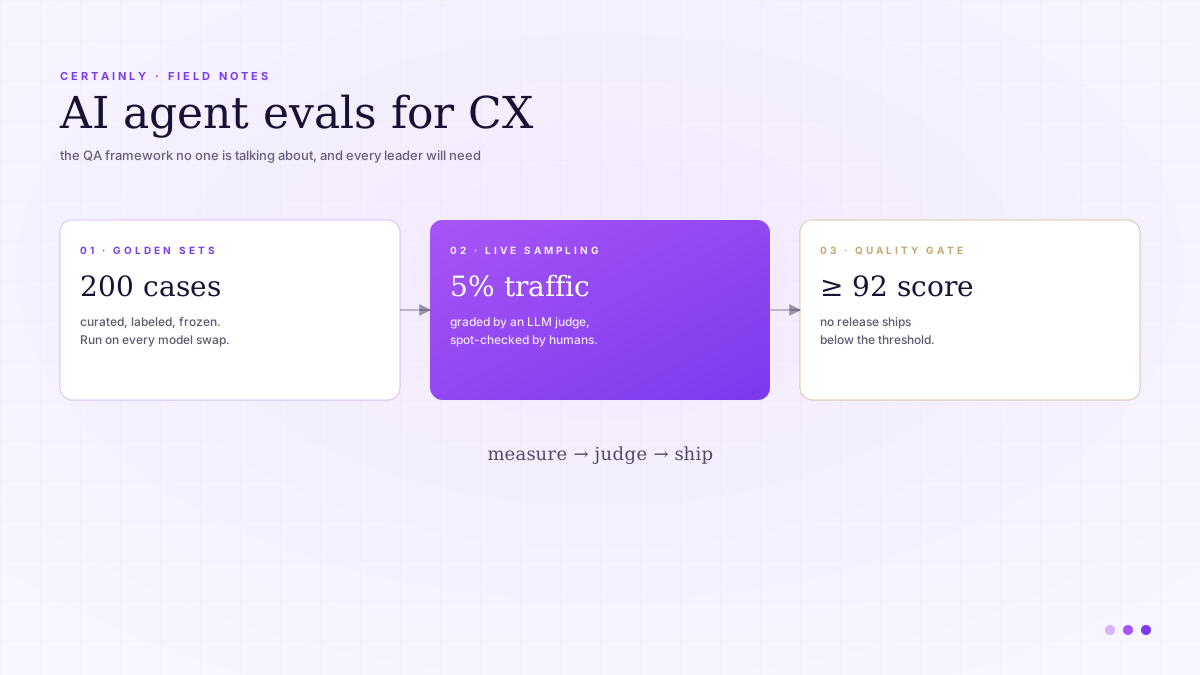
Most CX teams running agentic AI in production do not have a real evals framework. They have a spreadsheet of test cases, a vague intuition that quality is fine, and a quiet anxiety every time the model provider ships a new version. The teams that are running it well operate a three-layer system: a frozen golden set of cases for regression, a live sampling pipeline graded by an LLM judge with human spot-checks, and a quality gate that blocks any release scoring below a defined threshold. That system is what turns agentic deployment from a continuous source of unscheduled fire-fighting into a managed engineering discipline.
Evals are how serious software gets shipped. In most engineering disciplines, they are non-negotiable. In CX AI deployments, they are still treated as a nice-to-have, which is why so many programmes plateau six months in and then quietly regress.
The good news: the framework that fixes this is well understood, and standing it up takes a few weeks, not a few quarters.
Why Manual QA Stops Working
Most CX teams begin agentic deployment with a familiar pattern. A small group of operators reviews a sample of conversations each week, flags the bad ones, and feeds the issues back into the prompt or the policy.
That works for the first 30 days. Past that, three things break it.
Coverage collapses. Even a five percent manual review can only ever look at a tiny slice of the long tail of conversation types that actually drive customer dissatisfaction.
Regression is invisible. When a model is updated or a prompt is changed, there is no systematic way to know whether the change improved or degraded performance on cases the team is not currently sampling.
Subjectivity drifts. The reviewers calibrate to each other over time, and 'good' becomes whatever the team has been seeing recently rather than whatever the customer actually needed.
An evals framework solves all three by separating the unchanging benchmark from the live sample from the gating decision.
Layer One: Golden Sets
The foundation is a frozen set of 150 to 300 representative cases, hand-curated and labeled with the correct outcome. The set should cover the top contact drivers, the long-tail edge cases, the policy boundaries that the agent must never cross, and a small number of adversarial inputs designed to stress-test guardrails.
The golden set does not change. Every model swap, every prompt update, every new policy clause runs against it before it ships. The output is a single regression score that tells you, unambiguously, whether the change moved performance up or down on the cases the team has agreed to care about.
Three discipline points keep the golden set useful.
Curate it once, with input from product, support, and compliance. Re-litigating it every month destroys its value as a stable benchmark.
Keep it private. If the golden set leaks into the training data of the underlying model, you have lost your benchmark.
Refresh it on a slow cadence. Once a quarter, retire ten percent of the cases that no longer represent the current product, and add ten percent of new ones from real production conversations.
Layer Two: Live Sampling With an LLM Judge
Golden sets catch regressions on known cases. They cannot tell you about the new cases the system encounters every day. Live sampling closes that gap.
The pattern: take five percent of live production conversations, feed them through an evaluator model with a structured rubric, and produce a score for each on the dimensions that matter. A typical rubric for CX includes resolution accuracy, tone, policy adherence, escalation appropriateness, and brand safety.
An LLM judge sounds risky. It is, if you point it at unconstrained criteria. It works, reliably, when the rubric is specific, the scoring scale is small (1 to 5 is enough), and the model is given the same inputs the agent had.
Layer the judge with a human spot-check. Five to ten percent of the judge's outputs are reviewed by a person, and disagreements are used to recalibrate the rubric. The judge handles volume, the human keeps the system honest.
AI Readiness Score
How ready is your team for AI?
6 quick questions. Get a personalised score and action plan.
Try the AI Readiness Score1000+ agents deployed worldwide · 4.8 on G2
Layer Three: The Quality Gate
The third layer is the one most CX teams skip, and the one that turns evals from a reporting exercise into an engineering discipline.
A quality gate is a hard threshold. No model swap, no major prompt change, no new tool integration ships to live traffic without first scoring above the threshold on the golden set and matching or exceeding the previous quarter's live-sampling score on the rubric dimensions.
The threshold is set per organisation. Most operations land somewhere in the 90 to 94 range on a 100-point composite. The exact number matters less than the discipline of holding the line.
Two failure modes are common when the gate is first introduced.
Releases that have been queued for months suddenly fail and the temptation is to lower the gate. Resist it. The release is failing because it is genuinely worse on cases the business cares about.
The vendor of an underlying model insists their benchmarks show improvement. Their benchmarks are not your customers. Your golden set is.
What This Costs and What It Returns
A serious evals framework for a mid-sized CX deployment takes four to six weeks to stand up and one or two engineers part-time to run. The cost is real but small.
The return is meaningful. Teams that operate evals report 30 to 40 percent fewer production incidents in the first quarter, faster model upgrades because the regression risk is measured rather than feared, and a degree of executive confidence in the agentic deployment that simply does not exist in operations running on intuition.
Three Moves to Start This Quarter
Build the golden set first. Before anything else, sit a working group down for two days and produce 200 cases with their correct outcomes. That artifact will outlast every other tool you choose.
Stand up live sampling on a single case type. Pick the highest-volume one. Get the judge running, get the rubric stable, then expand.
Define the gate before you need it. Pick the threshold while the team is calm. Defending it under release pressure is far harder than agreeing it in a quiet meeting.
Evals are unglamorous. They are also the difference between an agentic AI deployment that compounds and one that quietly degrades until someone notices the CSAT drop and calls a crisis meeting.